
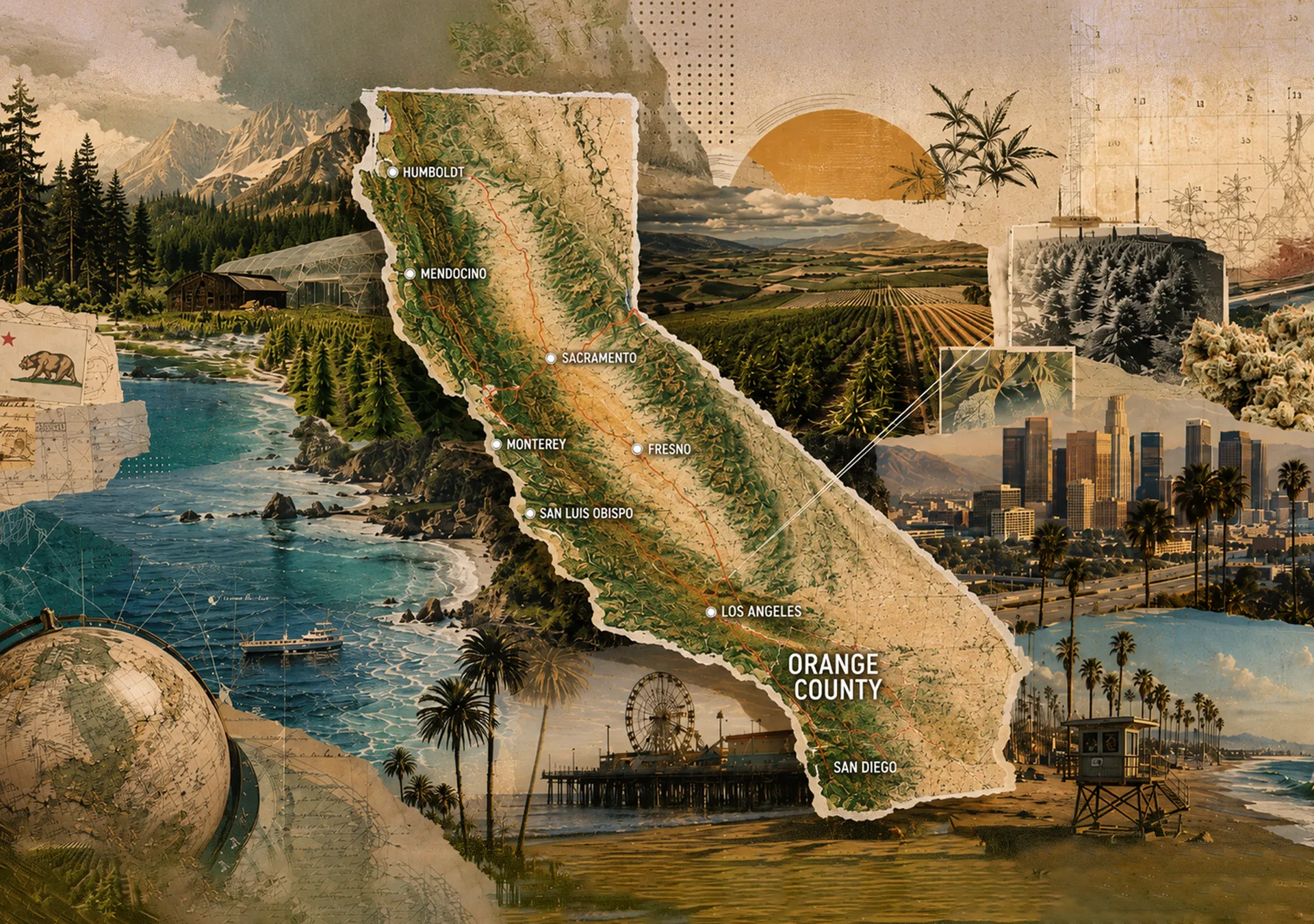
How California Became the Center of Modern Cannabis Culture
California did not invent cannabis.
The plant had been cultivated, consumed, traded, and used medicinally around the world for thousands of years before California ever became associated with it. Even within the United States, cannabis culture existed far beyond the West Coast.
What California did was different.
Over several decades, the state became one of the world’s most influential laboratories for cannabis cultivation, genetics, activism, retail, branding, manufacturing, and consumer culture. Northern California developed legendary growing regions. San Francisco helped transform medical cannabis from an underground practice into a political movement. Southern California became a center for indoor cultivation, strain culture, brands, extracts, and retail. Eventually, the state created a legal market large enough to turn ideas developed in garages, warehouses, rural farms, and medical collectives into an industry.
Calling California the cannabis capital of the world is therefore not simply a claim about which market currently sells the most cannabis. Market rankings change, and California faces serious competition from other legal markets.
The title is really about influence.
Few places have shaped what modern cannabis looks like, smells like, is called, how it is sold, or how governments regulate it as deeply as California has.
And Orange County has a larger place in that story than it usually gets credit for.
California Cannabis Started Long Before Legalization
It is easy to tell California cannabis history beginning with Proposition 215 in 1996.
The story goes back much further.
California actually began restricting cannabis in 1913, decades before modern legalization. Through much of the twentieth century, the state followed increasingly aggressive state and federal drug policies that pushed cannabis cultivation and consumption underground.
At the same time, California was becoming the perfect environment for a counterculture to grow around the plant.
The state had enormous geographic diversity, a large population, major ports, university communities, music scenes, agricultural knowledge, proximity to Mexico, and a cultural reputation for experimentation. San Francisco became a center of the 1960s counterculture while communities throughout Northern California attracted people looking for alternatives to conventional urban life.
Cannabis moved with them.
By the 1970s, something important was beginning to happen in the hills of Northern California.
The Emerald Triangle Turned Cannabis Into a Craft
Humboldt, Mendocino, and Trinity counties eventually became collectively known as the Emerald Triangle.
The name would become almost mythical within cannabis culture.
Beginning around the late 1960s and accelerating through the 1970s, people associated with the back-to-the-land movement left cities such as San Francisco for remote communities in Northern California. Some established homesteads, farms, and communes in places where privacy, inexpensive rural land, and favorable growing conditions made small-scale cannabis cultivation possible.
Over time, cultivation became increasingly sophisticated.
Growers selected plants that performed well in the local environment. Seeds were saved. Genetics were exchanged. Cultivation knowledge moved between neighboring farms and generations of growers. Techniques improved because there was a powerful incentive to produce better cannabis in limited spaces while remaining hidden from law enforcement.
By the end of the 1970s, research from UC Berkeley describes the Emerald Triangle as a net exporter of cannabis.
That is a remarkable transition.
A rural counterculture had begun becoming an agricultural economy.
Prohibition Accidentally Encouraged Better Cannabis
Cannabis prohibition created enormous harm, but it also shaped the way California growers cultivated the plant.
Outdoor gardens had to remain hidden.
Law enforcement surveillance pushed growers toward smaller plots and increasingly discreet production. By the late 1980s, cultivation expanded into indoor environments, allowing growers to control light, temperature, nutrients, flowering schedules, and other variables while keeping plants out of sight.
Indoor cultivation changed cannabis dramatically.
Growers were no longer limited to one outdoor harvest each year. Plants could be propagated through cloning. Specific female plants could be preserved indefinitely. A remarkable phenotype no longer had to disappear after harvest because a cutting from that exact plant could be maintained and reproduced.
That helped create the modern idea of a cultivar as a specific selection, not merely a bag of seeds with a name.
California growers became obsessed with finding and preserving exceptional plants.
The consequences are still visible on dispensary menus today.
California Helped Build the Modern Genetic Library
Some of the most influential names in cannabis became inseparable from California.
Haze.
Kush.
OG.
Z.
Not every one of those genetic families originated entirely in California, and cannabis lineage history is often messy because much of the breeding happened during prohibition. Seeds and clones crossed state and international borders, stories changed as they were retold, and records were rarely maintained in the way modern agricultural breeders might document a commercial crop.
What California did exceptionally well was turn genetics into culture.
A particular cut could become famous.
Growers became known for specific selections. Consumers learned to recognize strain names. Certain aromas became associated with regions and eras. Cannabis began developing the type of provenance more commonly associated with wine, coffee, or other specialty agricultural products.
Southern California became especially influential in the development and popularity of OG Kush and its descendants.
That legacy still defines part of the state’s flavor today.
Southern California Made Gas a Standard
Ask longtime Southern California flower consumers what premium cannabis is supposed to smell like and many will eventually arrive at some version of the same answer.
Gas.
OG Kush became one of the defining cultivars of Southern California cannabis culture, even though its precise historical origin remains disputed. What is not disputed is the enormous influence the strain and its descendants had on the region.
SFV OG, Tahoe OG, Fire OG, Larry OG, Ghost OG, and countless other Kush and OG selections helped establish fuel, pine, lemon, earth, and skunk-forward aromas as signs of desirable flower.
Los Angeles and surrounding Southern California cultivation scenes pushed those profiles through indoor gardens, medical dispensaries, music culture, and an increasingly sophisticated consumer market.
California cannabis was no longer known only for where it was grown.
It was becoming known for how it smelled.
That distinction eventually helped create the genetics-driven dispensary culture we have today.
The AIDS Crisis Changed Cannabis History
California’s influence was not built only by growers.
Some of the most important people in the state’s cannabis history were patients, caregivers, nurses, activists, and members of San Francisco’s LGBTQ+ community.
During the AIDS crisis of the 1980s and early 1990s, people living with HIV and AIDS used cannabis in an effort to manage symptoms including nausea, appetite loss, and pain. Doing so still exposed them to arrest.
Activists including Dennis Peron and Mary Jane Rathbun, better known as Brownie Mary, became central figures in changing that reality.
Rathbun became famous for providing cannabis brownies to people with AIDS and other seriously ill patients. Peron, whose partner Jonathan West died from AIDS in 1990, helped organize patient access and later operated the San Francisco Cannabis Buyers Club.
The Buyers Club was more than a place to obtain cannabis.
It created a visible community of people who could demonstrate why access mattered.
The argument around cannabis began changing from abstract debates over drug policy to a much harder question: should seriously ill people be arrested for using a plant they believed helped them eat, sleep, manage nausea, or endure treatment?
California voters eventually answered that question.
Proposition 215 Changed America
On November 5, 1996, California voters approved Proposition 215, the Compassionate Use Act.
The measure protected qualified patients and their primary caregivers under California law for the possession and cultivation of cannabis when recommended by a physician.
California became the first state in the country to approve medicinal cannabis through a statewide vote.
The significance went far beyond California.
A state with one of the largest populations and economies in the country had directly challenged decades of cannabis prohibition by creating legal protections for medical use.
Other states followed.
Medical cannabis programs spread across the United States, although the structure and rules varied widely from state to state.
California had opened a door that would become extremely difficult to close.
The Medical Era Became Cannabis’s Testing Ground
Proposition 215 did not immediately create the tightly regulated dispensary system Californians recognize today.
The medical market evolved gradually and often confusingly.
In 2003, Senate Bill 420 further clarified California’s medical cannabis framework and addressed collective and cooperative cultivation. Over the following years, medical dispensaries expanded throughout portions of the state while local governments experimented with their own rules.
That period became one of the most creative eras in modern cannabis.
Flower breeding accelerated.
Concentrates developed rapidly.
Edible companies became more sophisticated.
Pre-rolls evolved.
Vape technology emerged.
Packaging improved.
Dispensaries learned merchandising.
Cannabis brands began developing recognizable visual identities.
A generation of growers, extractors, edible makers, retailers, breeders, and consumers effectively learned how a cannabis industry could work before the state had created the modern licensing system.
The medical market was inconsistent and imperfect, but it functioned as an enormous innovation lab.
Many ideas that now seem normal in legal cannabis were tested there first.
California Turned Strains Into Brands
During the medical era, cannabis began moving from anonymous product toward recognizable intellectual property.
A great batch of flower was no longer simply “good weed.”
It might be OG Kush from a particular grower.
A specific phenotype of Gelato.
A famous Cookies selection.
A clone passed through a tightly controlled network.
A hashmaker known for working with certain cultivators.
The identity surrounding the plant became increasingly important.
That development eventually produced some of the most influential cannabis brands in the country.
Cookies helped demonstrate how genetics, streetwear, music, visual identity, and cannabis could operate inside the same cultural ecosystem. Jungle Boys became synonymous with a particular style of Southern California indoor flower. Companies including CBX built cultivation reputations that survived from the medical era into the regulated market.
Later generations of brands expanded that influence into vapes, pre-rolls, concentrates, edibles, beverages, and other categories.
California did not just grow cannabis.
It taught cannabis how to become a consumer culture.
Proposition 64 Changed the Scale Again
Twenty years after Proposition 215, California voters approved another major cannabis initiative.
Proposition 64, passed in November 2016, legalized cannabis possession and use under state law for adults 21 and older while creating the framework for regulated commercial adult-use businesses.
California’s licensed adult-use marketplace began operating on January 1, 2018.
The transition was enormous.
Businesses that had developed under the medical system now faced state licensing, testing requirements, track-and-trace rules, packaging standards, taxes, local permits, distribution requirements, and an entirely different compliance environment.
Not everyone survived.
Some legacy operators were unable or unwilling to transition. Others struggled with taxes, falling wholesale prices, regulatory costs, limited local retail access, and competition from an illicit market that never disappeared.
Legalization did not make California cannabis easier.
It made it official.
California Became an Enormous Legal Market
Despite those challenges, the scale of California cannabis remains extraordinary.
Headset reported approximately $332.9 million in tracked California cannabis sales in July 2026, making California the largest legal cannabis market in the United States in its dataset.
State tax records show the scale from another perspective. California retailers reported nearly $957 million in cannabis sales during the first quarter of 2026 for purposes of the state cannabis excise tax.
Since legal adult-use sales began in 2018, California cannabis has also generated billions of dollars in state tax revenue. By the third quarter of 2025, the California Department of Tax and Fee Administration reported more than $7.6 billion in cumulative cannabis tax revenue since January 2018.
Those numbers matter, but they do not tell the entire story.
California’s influence has always been larger than its legal sales totals.
Genetics bred here travel.
Brands developed here influence other markets.
Cultivation techniques spread.
Packaging trends spread.
Product formats spread.
Consumer expectations spread.
California has effectively spent decades exporting cannabis culture.
Northern and Southern California Built Different Parts of the Industry
One reason California became so influential is that no single region had to do everything.
Northern California built much of the state’s agricultural mythology.
Humboldt, Mendocino, and Trinity became globally recognized for outdoor and small-farm cultivation. The Bay Area contributed breeding, patient activism, dispensary culture, and major political organizing.
Southern California developed differently.
Los Angeles and surrounding counties became centers for indoor cultivation, retail, manufacturing, brands, extraction, entertainment-driven culture, and an enormous consumer population.
The modern licensed supply chain reflects that shift toward Southern California. Research from the Berkeley Cannabis Research Center found that Southern California accounted for nearly half of licensed cannabis product manifests between 2019 and 2023, with Los Angeles and Riverside counties accounting for a large share of supply-chain activity.
California cannabis therefore became less like one regional industry and more like an ecosystem.
Northern farms.
Central Coast greenhouse cultivation.
Southern California warehouses.
Urban manufacturing.
Extraction facilities.
Distribution hubs.
Retail stores.
Delivery operations.
Testing laboratories.
Brands.
Breeders.
Consumers.
Each piece helped strengthen the others.
Orange County Rarely Gets Included in the Story
When cannabis history is told geographically, Orange County is usually skipped.
Humboldt gets cultivation.
San Francisco gets medical activism.
Oakland and Berkeley get dispensary and social-equity history.
Los Angeles gets OG, Cookies, indoor cultivation, brands, and celebrity cannabis culture.
Orange County rarely gets a chapter.
That does not mean cannabis was absent here.
Orange County sits directly inside the Southern California cannabis economy, surrounded by Los Angeles, Riverside, and San Diego counties and home to millions of consumers. Cultivators, manufacturers, distributors, retailers, designers, marketers, and other cannabis businesses have operated throughout the region.
The difference is that many Orange County cities remained reluctant to allow licensed storefront retail.
One city moved earlier than most.
Santa Ana Became Orange County’s Early Cannabis Hub
In November 2014, Santa Ana voters approved Measure BB, establishing a regulatory program for medical marijuana businesses.
The measure received approximately 66% voter approval and authorized as many as 20 medical cannabis collectives or cooperatives.
According to the City of Santa Ana, that made Santa Ana the first jurisdiction in Orange County to license and regulate medical marijuana collectives.
That happened two years before California voters approved Proposition 64.
At a time when many surrounding cities wanted little to do with cannabis storefronts, Santa Ana was building a regulated local market.
The city subsequently expanded its framework as California transitioned toward adult-use legalization, creating regulations covering commercial cannabis retail and other licensed activities.
That decision positioned Santa Ana differently from much of Orange County.
Instead of forcing cannabis consumers entirely into neighboring counties or an unregulated market, the city created a legal retail ecosystem inside Orange County.
Orange County Became a Consumer Side of Cannabis Culture
Orange County was never going to become Humboldt.
It did not need to.
Cannabis economies need consumers and retailers just as much as they need farms.
Orange County’s role developed around the opposite end of the supply chain. The region’s dense population, freeway network, suburban communities, tourism economy, proximity to Los Angeles, and significant consumer purchasing power made it an important Southern California retail market.
Santa Ana became one of the clearest examples.
By 2026, cannabis revenue had become a meaningful line in the city’s budget. Santa Ana’s fiscal reporting estimated approximately $12.65 million in cannabis revenue for the 2025-26 fiscal year, with roughly $7.7 million received through March 31, 2026.
Those are city revenues, not dispensary sales, but they demonstrate how far the relationship between cannabis and local government has changed.
A product once sold entirely outside the legal economy is now contributing directly to municipal revenue.
That transformation happened within a generation.
California Created the Modern Dispensary Experience
The dispensary itself is another part of California’s influence.
Early medical cannabis access could look dramatically different from modern retail. Some collectives were small counters. Others operated more like patient clubs. Menus could be handwritten, products minimally packaged, and strain information largely dependent on whoever happened to be working that day.
Today’s California dispensary operates in another world.
Flower is divided by grower, strain, package size, price tier, and cultivation style. Vapes include multiple extraction types and hardware systems. Concentrates have developed their own technical vocabulary. Edibles are portioned and labeled. Pre-rolls range from basic whole-flower joints to elaborate infused products.
Customers can browse inventory before leaving home.
Delivery can bring the menu to them.
Loyalty programs remember previous purchases.
Email and mobile notifications announce new products.
Retailers become curators rather than simply places where cannabis is available.
As we explored in How California Cannabis Menus Have Evolved Since Legalization, the modern cannabis menu has become an entire consumer marketplace.
California helped build that model.
California’s Influence Is Also Cultural
Cannabis has always existed at the intersection of several California cultures.
Music.
Skateboarding.
Surfing.
Streetwear.
Lowriders.
Art.
Food.
Wellness.
Agriculture.
Nightlife.
The plant moved through those communities long before legal corporations could advertise it.
That cultural integration matters because it made cannabis feel like more than a product category.
A strain could become part of a song.
A grower could become famous.
A jar could have the visual identity of a fashion label.
A cannabis release could be treated like a drop.
A dispensary could participate in the same local culture as record stores, restaurants, coffee shops, galleries, and clothing brands.
California helped normalize the idea that cannabis could exist inside lifestyle culture without losing the cultivation culture underneath it.
The strongest brands still understand that balance.
Marketing can get someone to notice the jar.
The cannabis inside still has to be worth remembering.
California Also Shows How Difficult Legalization Can Be
Calling California the cannabis capital does not mean pretending the legal market is perfect.
It is not.
California’s licensed industry has dealt with falling wholesale prices, heavy competition, regulatory expenses, local bans on cannabis businesses, taxes, illegal-market competition, business closures, and consolidation.
The state itself has acknowledged many of these challenges.
Retail sales declined after reaching earlier highs, even while the number of products sold continued to grow. Wholesale flower prices fell sharply. Many cultivation businesses faced enormous financial pressure.
Legalization also did not automatically erase the illicit market.
That complexity is important to the California story.
The same state that helped demonstrate what cannabis legalization could become is now demonstrating how difficult it is to transition a massive underground economy into a sustainable regulated one.
California remains an experiment.
It just happens to be the biggest cannabis experiment the United States has ever attempted.
So Why California?
There is no single reason California became the center of modern cannabis culture.
It was geography and climate.
It was the back-to-the-land movement.
It was Humboldt growers learning to cultivate under prohibition.
It was breeders preserving exceptional plants.
It was indoor growers developing techniques that could produce cannabis year-round.
It was Southern California’s obsession with OG.
It was San Francisco AIDS activists refusing to accept that sick people should be arrested for cannabis.
It was Proposition 215.
It was the medical dispensary era.
It was hashmakers, edible producers, breeders, growers, retailers, and patients experimenting before the rest of the country knew what a legal cannabis industry might look like.
It was Proposition 64.
It was branding.
Music.
Fashion.
Technology.
Delivery.
Retail.
And millions of consumers willing to support all of it.
No other explanation is complete on its own.
California became cannabis’s most influential state because all of those things happened here at the same time.
Orange County Is Part of What Comes Next
Orange County may not have the cannabis mythology of Humboldt or the historical reputation of San Francisco.
Its importance is more modern.
This is where cannabis is becoming ordinary retail.
A customer can browse hundreds of products online, compare cultivators, order delivery, earn loyalty points, shop value flower or premium genetics, and encounter brands whose histories stretch from underground gardens to statewide legal businesses.
Santa Ana’s decision to regulate medical cannabis in 2014 helped establish one of Orange County’s earliest legal cannabis markets. Today, the city remains part of a much larger Southern California ecosystem connecting cultivators, brands, manufacturers, distributors, retailers, and consumers.
Tropicanna exists inside that next chapter.
Our shelves bring together many different pieces of California cannabis history. There are modern genetics descended from Cookies, Gelato, Z, and Runtz alongside OG cultivars that connect directly to Southern California’s earlier flower culture. There are brands that began during the medical era, newer companies built entirely within legalization, solventless hash, live resin, beverages, edibles, pre-rolls, vapes, value flower, and premium indoor cultivation.
A customer standing in a Santa Ana dispensary today can experience several decades of California cannabis evolution without necessarily realizing it.
That may be the best explanation for why California became the cannabis capital in the first place.
The state never had only one cannabis culture.
It had dozens of them, developing in different places for different reasons, eventually meeting on the same menu.
And here in Orange County, that history is still being written.