
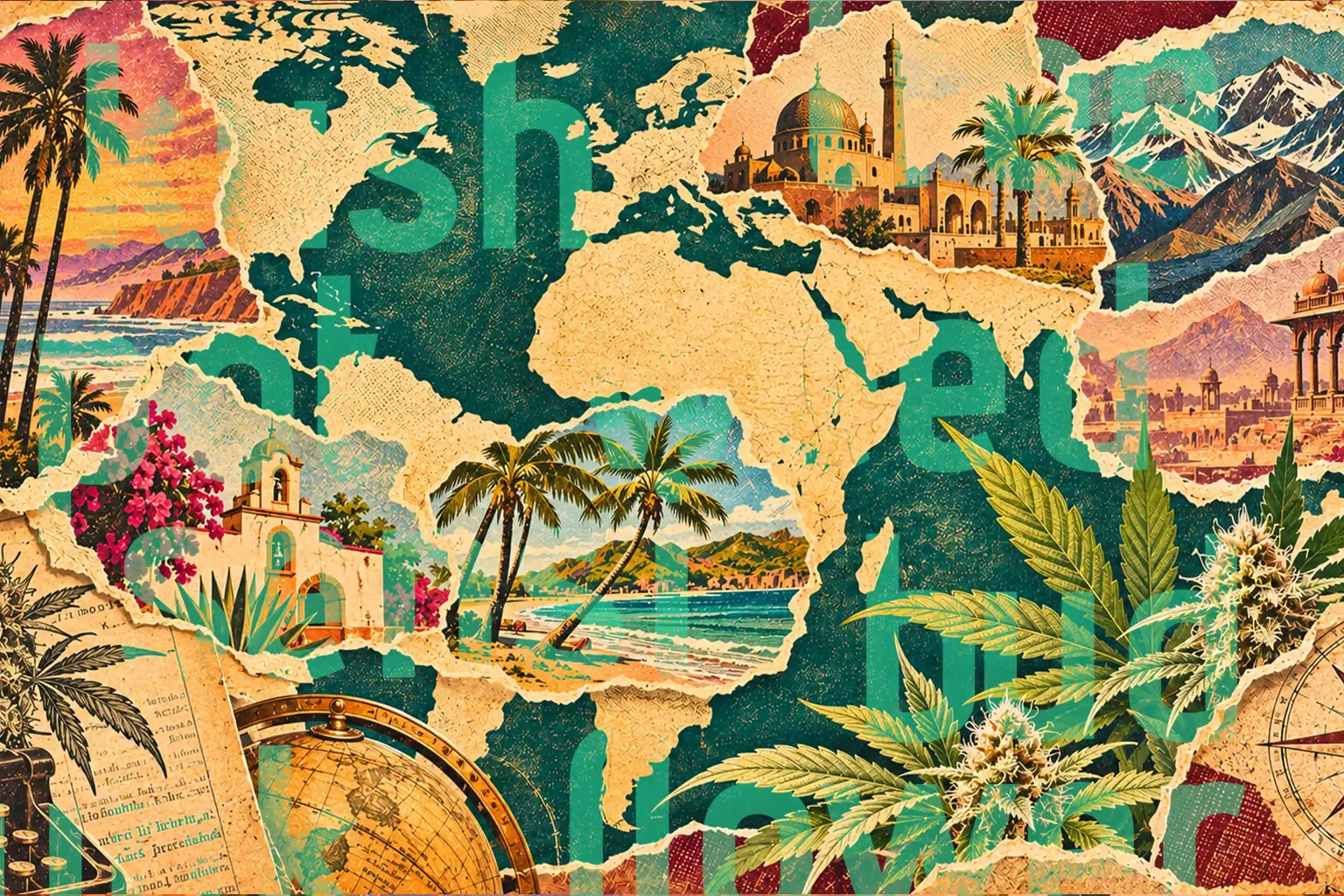
From Weed to Kush: The Surprising History of Cannabis Slang
Cannabis may have more nicknames than almost any other plant on Earth.
Weed. Pot. Ganja. Grass. Reefer. Mary Jane. Herb. Kush. Bud. Chronic. Dope. Green. Flower.
Some sound ancient. Others sound like they came from a 1990s rap record. A few began as words from completely different languages and cultures before traveling thousands of miles and eventually landing on American dispensary menus.
That vocabulary is not random.
Cannabis slang tells the story of the plant itself. Words followed trade routes, immigration, prohibition, music, underground culture, breeding communities, and eventually legalization. Some terms were created because people needed to speak discreetly. Others came from geography. Some were borrowed from languages that had been describing cannabis centuries before the United States existed.
And a few have origins that are still surprisingly difficult to prove.
So how did cannabis end up with so many names?
“Cannabis” Is Older Than Almost All the Slang
Before we get to weed, pot, and ganja, it helps to start with the word that now sounds the most official.
Cannabis is ancient.
The English word entered botanical language in the late 1700s through the Latin genus name Cannabis, but its roots go much farther back. The Latin term came from Greek kannabis, a word used for hemp and probably borrowed from languages spoken farther east in Eurasia.
Related words appear across multiple ancient language families.
That linguistic trail makes sense when you consider what we explored in Ancient Cannabis: The Strangest Archaeological Discoveries in Weed History. Cannabis moved through Central Asia, Europe, the Middle East, and surrounding regions for thousands of years as fiber, food, medicine, ritual material, and intoxicant.
The word traveled with the plant.
There is even a familiar English word hiding in the same family.
Canvas ultimately traces back through words meaning material made from hemp.
Cannabis may sound like modern scientific terminology, but the linguistic ancestry behind it is much older than the dispensary industry.
How Did Cannabis Become “Marijuana”?
This is where the history gets complicated.
The English word marijuana, historically also spelled marihuana, came into American usage through Mexican Spanish during the late nineteenth and early twentieth centuries.
Where the Mexican word itself came from is less certain.
You have probably heard the explanation that marijuana combines the Spanish names María and Juana, essentially “Mary Jane.”
It makes a great story.
It is probably backwards.
Historical dictionaries generally treat the original Mexican Spanish word as having an uncertain origin. The María Juana explanation appears to be a later folk interpretation of a word that already existed.
That did not stop English speakers from turning the association into another cannabis nickname.
By the late 1920s, Mary Jane was appearing as American slang for marijuana.
A questionable etymology essentially created a perfectly real second slang term.
Language is weird like that.
“Marijuana” Became Bigger Than the Word Itself
The rise of marijuana in American English cannot be separated from prohibition.
Cannabis was already known in American medicine and agriculture under names such as cannabis and hemp. But during the early twentieth century, the Mexican Spanish term marijuana increasingly appeared in newspapers, law enforcement discussions, drug-control campaigns, and sensational stories about intoxicating cannabis.
That history is often simplified into a neat story claiming American officials deliberately invented the word to associate cannabis with Mexican immigrants.
The real history is more complicated.
Historian Isaac Campos has shown that marijuana already had a substantial history in Mexico itself, where fears about the plant’s supposed connections to insanity and violence developed before American federal prohibition. Those ideas and the word itself later traveled north.
American prohibition campaigns absolutely became entangled with racial stereotypes and sensationalism, but the vocabulary did not originate from one simple government marketing campaign.
By 1937, the federal Marihuana Tax Act had placed the spelling directly into U.S. law.
A regional Mexican term had become one of America’s dominant names for cannabis.
Today, parts of the industry prefer “cannabis” because it sounds more scientifically precise and because of marijuana’s complicated political history.
But the older word never disappeared.
“Weed” Was Already Slang Nearly a Century Ago
“Weed” feels modern because it remains one of the most natural ways Americans talk about cannabis today.
It is actually pretty old.
The word itself goes back to Old English and originally referred broadly to plants or herbs, eventually narrowing toward the familiar meaning of an unwanted plant.
It was also used as slang for tobacco centuries ago.
By the 1920s, American speakers were using weed for marijuana.
That transition does not require much explanation.
Cannabis is a plant.
Calling it “the weed” or simply “weed” was an easy piece of informal language, especially when direct references to cannabis could attract unwanted attention.
What is interesting is how durable the term became.
Other cannabis slang from the same era now sounds almost antique.
We still say weed constantly.
The word survived prohibition, jazz culture, the hippie era, the War on Drugs, medical cannabis, legalization, and modern dispensary culture without needing much reinvention.
Sometimes the simplest slang wins.
Pot Has One of the Strangest Origin Stories
Then there is pot.
It is one of the most recognizable cannabis words in American English, and linguists still cannot say with complete confidence where it came from.
The cannabis meaning appears in American slang during the 1930s.
A frequently repeated explanation traces it to Mexican Spanish words such as potiguaya or potaguaya, supposedly connected to a drink containing cannabis.
You will find that explanation in major dictionaries.
There is just one problem.
Lexicographers have had difficulty finding strong historical evidence showing that the proposed Spanish phrase was actually used the way the explanation requires.
Other theories have suggested connections to teapots, flowerpots, smoking equipment, or other drug slang.
None has produced a definitive answer.
The honest history of “pot” is therefore less satisfying but more interesting:
We know roughly when Americans began using it. We do not know exactly why.
For one of the most famous cannabis words in the English language, the trail simply goes cold.
Ganja Traveled Much Farther
Ganja has a completely different history.
The word entered English from Hindi, where forms of gāñjā referred to cannabis. Those words themselves trace back to older Sanskrit terminology associated with hemp.
English records of ganja appear by around the beginning of the nineteenth century, when British colonial officials, physicians, and writers were documenting cannabis preparations used across India.
This is where cannabis terminology becomes especially useful.
Historically, different South Asian words could distinguish different preparations of the plant.
Bhang often referred to preparations using leaves.
Charas referred to cannabis resin.
Ganja generally referred to flowering material prepared for consumption.
Those distinctions developed within cultures that had long-standing relationships with cannabis, rather than emerging from modern American dispensary categories.
The word then traveled.
How Ganja Became Associated With Jamaica
Ask many Americans where the word ganja comes from and Jamaica may be the first answer.
That association is understandable.
Cannabis became deeply embedded in Jamaican Rastafari culture, reggae music carried that culture internationally, and musicians helped make ganja recognizable around the world.
But the word itself came from South Asia.
The missing part of the story is migration.
After slavery was abolished in the British Empire, large numbers of indentured laborers from India were brought to Caribbean colonies during the nineteenth century.
They brought language, food, religion, customs, and cultural practices with them.
Cannabis terminology traveled too.
In Jamaica, ganja became part of local vocabulary and eventually part of Rastafari spiritual practice and cultural identity.
Reggae then gave the word a global microphone.
By the time Bob Marley and other Jamaican artists became international icons, “ganja” no longer sounded like an obscure South Asian loanword.
It sounded like cannabis culture.
A word can travel almost as far as a plant.
Kush Was a Place Before It Was Weed
Few cannabis words have changed meaning as dramatically as Kush.
Today, someone saying “Kush” may simply mean strong cannabis.
On a dispensary menu, Kush appears in countless cultivar names.
OG Kush.
Hindu Kush.
Master Kush.
Bubba Kush.
Purple Kush.
But Kush originally points to geography.
The Hindu Kush is a major mountain range stretching through Afghanistan and Pakistan into the broader Central and South Asian region.
Cannabis populations cultivated around that area became famous for their short, stocky plant structures, resin production, and suitability for hashish production.
During the 1960s and 1970s, travelers moving through what became known as the Hippie Trail brought seeds from Afghanistan, Pakistan, India, Nepal, and surrounding regions back to Europe and North America.
Those genetics had a massive influence on modern cannabis breeding.
The geographic name followed them.
Kush Eventually Became Bigger Than the Hindu Kush
Once those genetics entered Western breeding programs, Kush stopped functioning only as a geographic description.
It became a genetic and cultural category.
Then things got even messier.
Southern California’s rise of OG Kush during the 1990s helped transform Kush into one of the most commercially powerful words in cannabis. OG Kush itself has a famously disputed origin story, and its relationship to traditional Hindu Kush genetics is not as simple as the name might suggest.
But the name became enormous.
As OG crosses spread across California, “Kush” increasingly became shorthand for desirable cannabis, particularly dense, potent, often fuel-forward flower associated with West Coast culture.
Eventually, rappers were using Kush almost as a synonym for high-quality weed.
That is an incredible linguistic journey.
A mountain range became a regional cannabis designation.
The designation became part of strain names.
The strain names became slang.
Geography became lifestyle vocabulary.
“Hash” Started as an Arabic Word
Cannabis terminology has been crossing cultures for much longer than modern strain names.
Hashish comes from the Arabic ḥashīsh, a word historically associated with dry herb, grass, or hemp.
English travelers were recording versions of the word by the late sixteenth century, although hashish became much more familiar in Europe during the nineteenth century.
Eventually, English speakers shortened it to hash.
The modern product category refers to concentrated cannabis resin or separated trichomes that have been collected and usually pressed or otherwise processed.
The word has survived remarkably well.
We explored that longer history in The History of Hash: From the Himalayas to California, where traditional resin-making cultures eventually connect to modern dry sift, ice-water hash, and solventless concentrates.
The technology evolved.
The old name stayed.
Kief Has an Arabic Story Too
Even kief, the dusty layer of trichomes collected in the bottom chamber of a grinder, carries linguistic history.
The term is related to Arabic kayf or kif, associated with pleasure, well-being, or enjoyment and later with cannabis preparations in parts of North Africa.
The cannabis industry eventually standardized “kief” around the loose trichome material separated from flower.
That means two of the most common words in modern concentrate vocabulary, hash and kief, ultimately connect English-speaking cannabis consumers back to Arabic terminology.
A modern grinder contains a surprisingly old language lesson.
“Joint” Did Not Originally Mean a Cannabis Cigarette
Joint might be the most ordinary word on this list.
It also took a very strange route.
The word originally comes from the idea of things being joined together. By the nineteenth century, American slang was using “joint” to describe places or establishments, particularly places with somewhat questionable reputations.
An opium den could be called a joint.
By the 1930s, American drug slang was using the same word for a cannabis cigarette.
Exactly why the meaning moved from the place to the thing being smoked is uncertain.
One popular explanation claims a joint received its name because people smoke it together and pass it around a group.
That sounds perfect.
There just is not strong historical evidence proving it.
Once again, cannabis slang gives us a believable story that may have been invented after the word already existed.
Reefer Came Out of the Same Era
Another famous old-school term is reefer.
The word was already being used for cannabis cigarettes by the 1920s and early 1930s.
Its precise origin is uncertain.
One theory connects it to Mexican Spanish grifo or grifa, words historically associated with cannabis or cannabis intoxication. Another theory connects the term to the nautical verb “reef,” because a rolled cigarette could resemble something rolled or folded tightly.
Nobody has conclusively solved it.
What we do know is that reefer became embedded in American jazz-era cannabis culture.
Then prohibition propaganda gave the word an entirely different kind of immortality.
“Reefer Madness” Turned Slang Into Propaganda
The 1936 film eventually known as Reefer Madness became one of the most infamous pieces of anti-cannabis propaganda in American history.
The movie portrayed cannabis as a pathway to insanity, violence, moral collapse, and tragedy.
By modern standards, it is so exaggerated that it eventually became camp.
The title also preserved an older piece of cannabis slang long after normal conversation moved on.
People rarely walk into dispensaries today asking for “reefer.”
But nearly everyone familiar with cannabis history recognizes “Reefer Madness.”
Sometimes prohibition accidentally preserves the words it is trying to stigmatize.
Mary Jane Was Basically a Linguistic Joke
Remember the uncertain story connecting marijuana with María Juana?
English speakers ran with it.
By the late 1920s, Mary Jane was being used as slang for cannabis.
The nickname works because Mary Jane is an English equivalent of María Juana.
But because the idea that marijuana literally comes from the names María and Juana is probably folk etymology, Mary Jane is essentially slang built on top of a misunderstanding.
That did not matter culturally.
The term became widespread enough to appear in music, movies, television, and everyday cannabis vocabulary for generations.
Once slang catches on, historical accuracy has very little control over what happens next.
Grass Belongs to a Different Generation
“Weed” survived.
Grass mostly aged out.
The slang use of grass for cannabis became established by the 1940s and became especially recognizable during the 1960s and 1970s counterculture era.
The logic is obvious enough.
Dried cannabis is green plant material.
Grass provided another indirect way to describe it.
For Baby Boom-era cannabis culture, the term became extremely familiar.
Today it sounds noticeably more dated.
That tells us something important about slang.
Some words become permanent.
Others become timestamps.
If someone calls cannabis “grass,” you may learn something about when they learned cannabis vocabulary before you learn anything about what they are smoking.
Cannabis Slang Became Connected to Jazz
Long before cannabis became synonymous with hippies or West Coast rap, it had an important relationship with American jazz culture.
Cannabis circulated through parts of the jazz scene during the 1920s and 1930s, particularly in cities such as New Orleans, Chicago, and New York.
Musicians and their communities developed their own vocabulary.
Cannabis could be called tea.
A joint might be a muggle.
Other terms appeared and disappeared inside particular scenes.
Slang served a practical purpose because cannabis was increasingly criminalized.
But it also served a cultural purpose.
Knowing the language told people you belonged.
That function of slang never really disappeared.
420 Might Be the Best-Documented Cannabis Slang Story
Most cannabis slang origins become fuzzy when you trace them far enough back.
420 is different.
The strongest evidence points to a group of friends at San Rafael High School in Northern California known as the Waldos.
In 1971, the teenagers arranged to meet after school at 4:20 p.m. while searching for an abandoned cannabis crop they had heard about.
Their original phrase was reportedly “420 Louis,” referencing both the meeting time and a statue of Louis Pasteur where they gathered.
Eventually, it was shortened to 420.
The group started using the number as a private code for cannabis.
Their connections to people around the Grateful Dead scene helped the term spread beyond their immediate circle. A flyer distributed at a Grateful Dead-related gathering in 1990 later reached High Times, which helped popularize 420 nationally and internationally.
A group of California teenagers accidentally created the most famous cannabis code in the world.
Sometimes the real story is better than the myths.
No, 420 Is Not a Police Code for Weed
The Waldos story also gives us one of cannabis culture’s favorite examples of false etymology.
For years, people claimed 420 was a police radio code for marijuana possession.
It was not.
Others claimed there were exactly 420 chemical compounds in cannabis.
Also not the origin.
There were stories involving Bob Dylan, Dutch teatime, criminal codes, and April 20 birthdays.
None explains the slang.
The evidence behind the Waldos is unusually strong because the group preserved letters, newspaper material, and other documents containing 420 references from the period.
For once, cannabis history actually kept the receipts.
Why Cannabis Needed So Much Slang
There is a simple reason cannabis accumulated an enormous vocabulary during the twentieth century.
It was illegal.
When possession could result in arrest, people had incentives not to announce exactly what they were discussing.
Code words become useful.
“Weed” sounds harmless.
“Tea” sounds harmless.
“Mary Jane” sounds like a person.
“420” means absolutely nothing unless you already understand it.
Slang allowed cannabis communities to speak indirectly while simultaneously signaling membership to other people who knew the language.
That phenomenon is not unique to cannabis.
Underground communities constantly create vocabulary that outsiders do not immediately understand.
What makes cannabis unusual is how much of that underground vocabulary survived into legalization.
Hip-Hop Changed the Cannabis Dictionary Again
By the late twentieth century, cannabis slang was evolving through another major cultural engine.
Hip-hop.
Terms such as chronic, dank, dro, loud, kush, gas, and countless regional expressions moved through music and street culture before becoming familiar to cannabis consumers more broadly.
Dr. Dre’s 1992 album The Chronic gave one of those terms enormous cultural visibility.
Kush became deeply embedded in rap vocabulary.
“Gas” evolved into shorthand for pungent, desirable flower, eventually connecting directly to the flavor categories we discussed in Gas vs. Fruit: The Battle of Modern Cannabis Genetics.
Cannabis slang was no longer only hiding the plant.
It was describing quality.
Identity.
Flavor.
Status.
Regional culture.
A word like “gas” can now communicate something about aroma and genetics while also functioning as casual praise.
That is a very different job from calling cannabis “tea” so someone nearby would not know what you meant.
Legalization Is Changing the Language Again
Cannabis vocabulary is still moving.
Walk into a licensed California dispensary today and you are more likely to hear flower than grass.
Consumers ask for pre-rolls instead of marijuana cigarettes.
Concentrate vocabulary has expanded into live resin, rosin, badder, diamonds, sauce, full melt, and countless other terms.
“Strain” is increasingly being replaced by cultivar or genetic in more technically minded conversations.
Cannabis itself has replaced marijuana in much of the professional industry.
Meanwhile, ordinary consumers still say weed.
Language does not change all at once.
Old vocabulary and new vocabulary overlap for decades.
That is why a modern cannabis conversation can contain a two-thousand-year-old word, 1930s American slang, 1970s California code, 1990s hip-hop terminology, and a product category invented five years ago without anyone thinking it sounds strange.
Strain Names Created Their Own Language
Modern cannabis genetics added another layer.
Once breeders began creating thousands of named cultivars, cannabis names became a vocabulary of their own.
OG.
Kush.
Haze.
Diesel.
Cookies.
Gelato.
Cake.
Runtz.
Z.
Sherb.
Each word can now imply certain genetic families, flavor profiles, breeders, eras, or cultural associations.
Some began as specific cultivars and became entire naming conventions.
Gelato is a perfect example. What started as a particular California genetic lineage eventually influenced countless crosses whose names reference desserts, numbers, flavors, and related family branches.
The same thing happened with OG and Kush.
Cannabis terminology does not just describe the plant anymore.
It maps ancestry.
The Funny Part Is That Nobody Controls Any of This
There is no official cannabis language committee.
Nobody approves slang.
Nobody decides that one word is retired and another is now acceptable.
The vocabulary develops the same way cannabis genetics often did historically.
Someone creates something.
Other people like it.
They pass it along.
Eventually the origin becomes blurry.
A word that started in India can become associated with Jamaica.
A mountain range in Afghanistan can become California slang.
A Mexican Spanish word with uncertain origins can produce an English nickname based on an incorrect translation.
Five teenagers in San Rafael can accidentally create an international cannabis holiday.
That chaos is part of the history.
The Menu Is Basically a Language Museum
Once you know where some of these words came from, a cannabis menu starts looking a little different.
Kush points toward Central and South Asia.
Ganja carries South Asian and Caribbean history.
Hash carries Arabic history.
Marijuana carries Mexican and North American political history.
420 carries Northern California counterculture.
OG and Gelato carry more recent chapters of California breeding culture.
Weed somehow survived almost all of it.
Every generation added vocabulary because every generation built its own relationship with cannabis.
Some terms disappeared.
Some changed meaning.
Others became so ordinary that we stopped wondering where they came from.
Cannabis Language Keeps Passing Itself Forward
At Tropicanna, we spend a lot of time talking about genetics, cultivation, brands, concentrates, and the modern California market.
But the language surrounding all of those things carries its own history.
A customer asking for Kush is using a geographic name that traveled across continents before becoming embedded in California cannabis.
Someone saying “weed” is using slang that was already circulating before the Great Depression.
A 420 promotion references an inside joke created by California high school students more than half a century ago.
And tomorrow, someone will probably invent another cannabis word that makes absolutely no sense until everyone starts using it.
That may be the most consistent tradition in cannabis culture.
The plant keeps changing.
The language changes with it.
And somehow, every generation passes a few words along.