
BLEM Cannabis: The Cultivation Story Behind Unruly OG & More
California cannabis consumers are not known for staying loyal to one brand. There is always another drop, another breeder, another limited strain, or another jar promising higher THC, louder terpenes, rarer genetics, or the next cultivar everyone will suddenly be talking about.
That makes BLEM interesting. Instead of building its reputation around an endless cycle of novelty, the Southern California flower brand has developed a following around something much harder to manufacture: consistency.
For many customers, that consistency has a name. Unruly OG.
It is the kind of strain people return to because they already know what they expect when the jar opens: dense flower, unmistakable fuel, classic OG character, and a profile that feels connected to the Southern California cannabis culture that existed long before adult-use legalization. But Unruly is only part of the story.
Behind BLEM is more than two decades of cultivation experience, roots connected to influential Southern California genetics, founder Danny Barkho, and a company that has remained unusually focused on flower even as the California market pushes brands toward every possible product category. As of July 2026, BLEM ranked sixth among California flower brands in Headset-tracked retail sales. More than 90% of its tracked sales came from flower, and Headset listed the brand at more than 400 licensed California retailers.
Those numbers confirm the scale of the company. They do not fully explain the loyalty. To understand that, it helps to look at the cultivation history behind the brand.
The Cultivation Roots Behind BLEM
BLEM describes itself as a cultivation company first. Its roots are closely tied to Cali Lotus, the cultivation operation behind BLEM, which traces its history to Southern California in the early 2000s.
That earlier cultivation lineage includes work with genetics that longtime California consumers may recognize. Cali Lotus has been publicly associated with JetFuel OG and the cultivation of Billy Kimber OG and 40 Elephants, while BLEM continues to reference those genetics as part of the history that shaped the modern company. That background matters because premium cannabis branding changed dramatically after California legalization.
Once adult-use sales began in 2018, producing exceptional flower was no longer enough to build a successful statewide company. Brands suddenly needed compliant packaging, licensed distribution, retail relationships, marketing, merchandising, social media identities, sales teams, and enough recognition to survive dispensary menus containing hundreds of competing products.
Legacy cultivation experience did not automatically translate into success in the regulated market. BLEM had an important advantage. The cultivation came before the branding.
Danny Barkho and a Cultivator-First Philosophy
BLEM was founded by cultivator Danny Barkho, who has publicly identified himself as the founder of the company. That distinction helps explain BLEM’s priorities. The brand does not present itself as a lifestyle concept that later found someone to grow cannabis for it. BLEM describes itself directly as a cultivation company first, emphasizing more than 20 years spent developing indoor flower production.
The philosophy is straightforward. Marketing might convince someone to buy the first jar. The flower has to convince them to buy the second.
That sounds obvious, but maintaining that standard is increasingly difficult in California. Premium flower brands compete against value eighths, aggressive promotions, vertically integrated operators, constantly changing genetics, and consumers who may compare products based primarily on THC percentage before considering anything else. A premium flower company therefore needs to give customers a reason to spend more.
BLEM has largely built that reason around consistency. Not consistency in the sense that every strain looks or tastes the same, but consistency in the standards used to decide what deserves to carry the BLEM name. The company emphasizes genetics, flower structure, resin production, terpene expression, potency, cultivation quality, and the final smoking experience. That philosophy becomes especially clear when examining how BLEM selects new cultivars.
Hundreds of Plants Can Lead to One Strain
Developing a new cannabis strain is not as simple as crossing two famous parents and packaging whatever grows. Seeds from the same cross can produce plants with noticeably different characteristics. These variations are known as phenotypes.
One plant may produce stronger aroma. Another may grow with better structure. Another may develop heavier resin coverage. Another may look incredible but fail to deliver when it is actually smoked.
A serious phenotype hunt involves growing many plants and narrowing them down until the cultivation team finds the individual expression it believes is worth preserving. BLEM provided a clear example of this process in 2026.
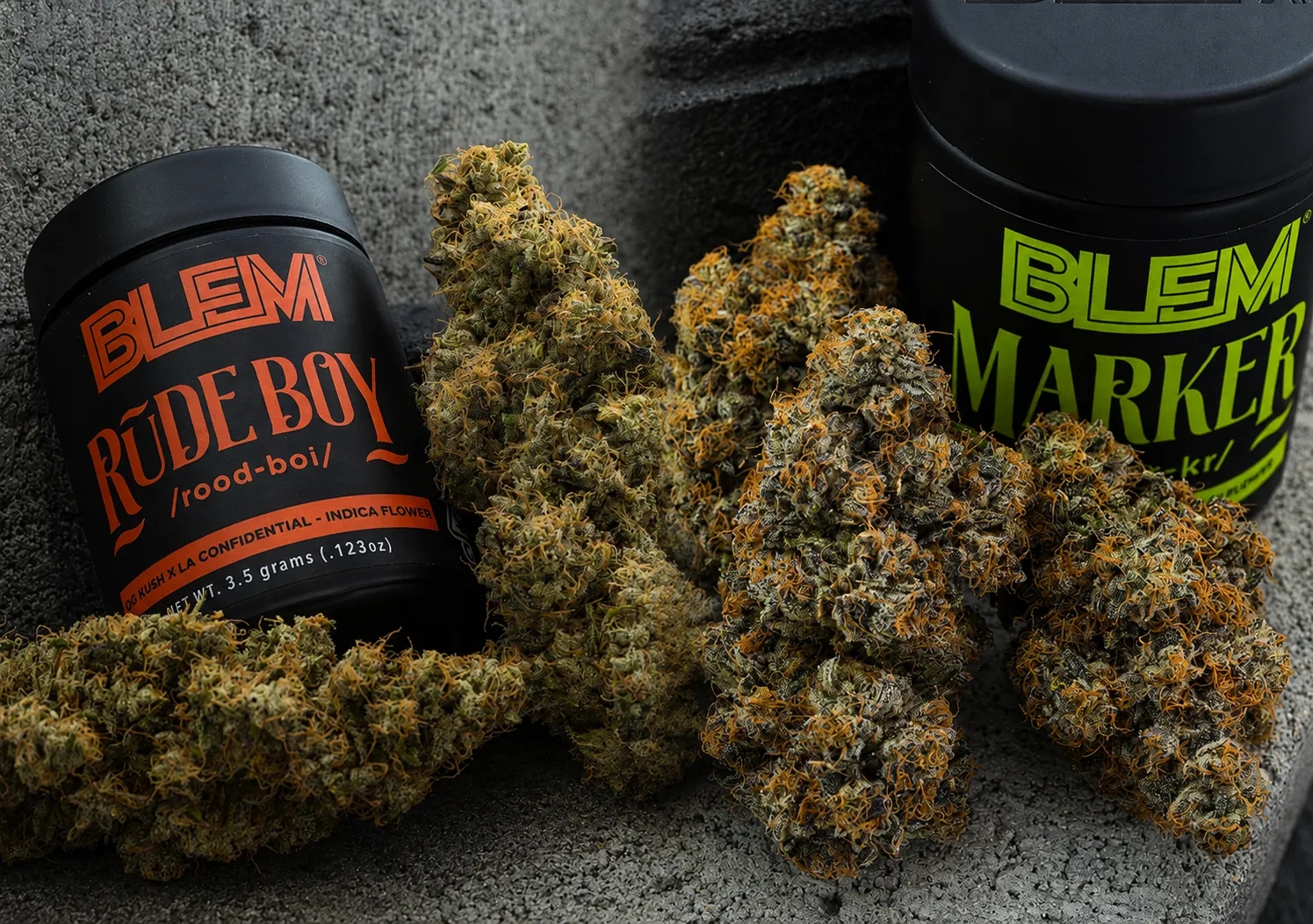
When developing new genetics, the company said its cultivation team evaluated hundreds of phenotypes. Plants were judged for vigor, resin production, terpene expression, flower structure, potency, and the smoking experience. Most were eliminated. The remaining selections went through additional evaluation before a final winner was chosen. One result was Rude Boy, an OG Kush x LA Confidential cultivar released in July 2026.
The process reveals something important about BLEM’s strategy. A recognizable genetic cross may create interest, but the names of the parents do not guarantee exceptional flower. The selected phenotype still has to earn its place.
BLEM’s willingness to evaluate hundreds of plants before selecting a release reinforces the idea that introducing something new is not the only objective. The strain has to fit the brand.
Unruly OG Became the Flagship
Every major flower brand eventually develops a strain that becomes inseparable from its reputation. For BLEM, that strain is Unruly OG. BLEM traces its Unruly cut to the early 2000s and identifies it as OG Kush. The profile is deliberately familiar: dense flower, heavy gas, earth, pine, citrus, and the unmistakable character associated with classic Southern California OG.
That simplicity is part of the appeal. Modern dispensary menus are filled with increasingly complicated genetic crosses. Customers regularly encounter cultivars with several famous parents, dessert genetics crossed into other dessert genetics, and names that may reveal very little about what the flower actually smells or tastes like.
Unruly moves in the opposite direction. It is selling familiarity. Consumers looking for traditional OG already have an expectation for what the flower should deliver. That creates a difficult standard.
If a company sells OG to someone who spent years smoking OG during California’s medical era, that customer probably already has a strong opinion about what the cultivar should smell like. BLEM has turned that expectation into one of its strengths.
On Weedmaps, Unruly has accumulated hundreds of consumer ratings, with verified purchasers frequently mentioning its gas-forward aroma, sticky texture, freshness, and resemblance to the OG profiles they remember. The reviews are not universally positive, which is normal for any widely sold cannabis product. Some customers have also commented on batch variation or value.
What matters is the volume of repeat interest surrounding the strain. Sales data provides additional evidence. From March through July 2026, the 3.5-gram Unruly OG remained BLEM’s top-selling tracked SKU on Headset. The 10-gram Unruly package consistently held the second position within the brand.
That is a stronger signal than a successful launch. Customers keep returning to the same cultivar.
Why OG Loyalty Runs Deeper
Unruly also benefits from arriving at an interesting moment in cannabis culture. As we explored in our article on The Return of OG Genetics, longtime consumers have begun showing renewed interest in gas-forward cultivars after years dominated by Cookies, Gelato, Runtz, Cake, and other dessert-oriented genetic families.
For those consumers, Unruly offers more than potency. It offers recognition. A strong OG aroma can immediately recall an earlier era of California cannabis, before recreational legalization, before elaborate packaging, and before most flower was discovered by scrolling through an online menu.
Cannabis nostalgia can be intensely sensory. People may forget the THC percentage on a product they purchased 15 years ago. They remember the smell. That emotional association becomes especially powerful when modern menus begin to feel crowded with sweet, creamy, fruit-forward, and candy-inspired profiles.
BLEM appears to understand that connection. When the company introduced Rude Boy in 2026, it framed the cultivar as a return to the OG genetics that helped establish its identity. The company is not treating older genetics like museum pieces. It is continuing to build around them.
Tangie Ting Proved BLEM Was More Than an OG Brand
If Unruly established BLEM among gas lovers, Tangie Ting demonstrated that the cultivation team could move in almost the opposite direction. Tangie Ting comes from Tangie genetics and is built around an intensely citrus-forward profile. BLEM describes the flower as smelling and tasting like freshly peeled tangerine.
The contrast with Unruly is dramatic. Unruly brings fuel, earth, pine, and OG. Tangie Ting brings bright orange citrus.
That difference is important because great cannabis cultivation should not force every cultivar into the same house profile. The goal is to allow different genetics to express their own characteristics clearly.
Tangie Ting has also become one of BLEM’s most commercially important products. In July 2026, it remained the brand’s third-best-selling tracked flower SKU, behind the two Unruly packages.
The strain has earned recognition outside sales data as well. At the 2024 California Cannabis Awards Music Festival, Tangie Ting took first place in the sativa flower category, while Unruly OG finished second in the indica flower category.
Two strains. Two completely different flavor directions. Both became recognizable enough to build audiences of their own. That is more meaningful than releasing dozens of cultivars that customers struggle to remember.
A Lineup Built Around Distinct Identities
Unruly and Tangie Ting remain the anchors, but BLEM has gradually developed a broader genetic library. Fiyah continues the company’s relationship with OG through an SFV OG selection associated with kerosene, fuel, earth, and lemon. Rail Up turns toward Trainwreck, another classic California genetic known for citrus and pine.
Bluberi combines Thin Mint GSC with DJ Short Blueberry, connecting modern Cookies genetics with one of cannabis breeding’s best-known legacy fruit lines. Graype uses Grape Ape genetics for a sweeter berry-oriented direction. Bomba moves toward funk through Hawgsbreath and GMO influences.
More recent phenotype hunts have continued expanding the lineup without completely abandoning BLEM’s legacy-oriented foundation. The pattern is range without randomness. Gas. Citrus. Fruit. Funk. Cookies influence. Trainwreck. Blueberry. OG. The menu gives consumers different directions while maintaining the sense that someone intentionally selected the genetics.
Flower Remains the Center of the Business
BLEM has expanded into several product formats, but flower remains overwhelmingly central to the company. Headset data from July 2026 showed approximately 91% of tracked BLEM sales coming from flower. That concentration is significant.
Many cannabis brands expand aggressively into vapes, edibles, concentrates, beverages, and infused products as they grow. BLEM has remained closely associated with jars of flower. Even its standard pre-roll program reinforces that identity.
BLEM states that its pre-rolls use the same whole flower that goes into its jars, with no trim and no shake. The company describes the material as hand-trimmed, slow-cured, and handled in small batches. That distinction matters.
Consumers can inspect whole flower visually before purchasing, especially when packaging allows it. A pre-roll hides the material inside the paper. Using whole flower allows BLEM to present the pre-roll as another format for its cultivation rather than as a secondary product made from lower-grade material. For a flower-focused company, protecting that reputation matters.
The Name Carries Its Own Culture
BLEM does not communicate like a traditional luxury cannabis brand. The name comes from Caribbean dancehall and patois slang and refers to being extremely high. That linguistic influence continues throughout the company’s naming system and visual identity.
Unruly. Tangie Ting. Boasy. Cyattie. Bluberi. Fiyah. Rail Up.
The vocabulary creates an identifiable BLEM world rather than treating every strain as an unrelated product. That identity extends into merchandise, apparel, collaborations, events, and limited releases.
But lifestyle branding only works long term when the product gives people a reason to care about the logo. Cannabis consumers have seen plenty of companies with impressive packaging and average flower.
BLEM’s cultivation reputation allows the cultural side of the brand to feel connected to something real. People recognize the branding because they already recognize the cannabis. That order matters.
ColdFire Collaborations Expand the Genetics
BLEM has also expanded its reach through collaborations rather than attempting to become an expert in every cannabis category itself. One of the clearest examples is its relationship with ColdFire, one of California’s better-known extract and vape producers. The partnership allows BLEM flower and genetics to move into another format while ColdFire handles extraction.
The companies have collaborated on products based on cultivars including Unruly OG, Tangie Ting, and Jet Fuel OG. The products have performed exceptionally well. In July 2026, the ColdFire x BLEM Unruly OG cured-resin cartridge ranked as ColdFire’s top-selling tracked SKU on Headset.
The Jet Fuel OG collaboration ranked second. Tangie Ting ranked third. In August 2026, the two companies expanded the relationship again with a limited Unruly OG cured-resin badder made using BLEM-grown flower.
That is a smart form of brand extension. The format changes. The genetic identity stays recognizable. A customer who already understands Unruly as flower can experience the cultivar through extraction without BLEM needing to abandon the cultivation story that built its reputation.
Freshness Matters More at a Premium Price
Premium flower has a shelf-life problem. Cannabis does not suddenly become unusable after a specific date, but the qualities customers often pay higher prices for can decline over time.
Aroma fades. Moisture changes. Terpenes volatilize. Flower can become brittle. The experience may become noticeably less expressive.
That creates a particular challenge for premium eighths. A customer paying premium pricing expects the product to feel premium when the jar opens. Consumer feedback provides some evidence of that freshness reaching retail. Verified Weedmaps purchasers have specifically noted Unruly packages dated only one or two weeks before purchase and described the flower as fresh and sticky.
That kind of feedback matters because freshness is difficult to communicate through advertising. Customers notice it when they open the jar. For a repeat buyer, that moment becomes part of the brand promise.
Premium Pricing Raises the Expectations
BLEM occupies a premium price tier. That naturally creates debate. Some consumers describe the quality as worth seeking out while still criticizing the price. Others mention waiting for promotions before repurchasing.
That tension is normal in premium cannabis. A company asking customers to spend more has to justify the difference every time. The jar cannot rely indefinitely on reputation.
If the cure slips, the flower arrives old, the strain lacks aroma, or one harvest performs significantly worse than the previous one, customers notice. Premium pricing therefore makes consistency more important, not less.
BLEM’s position within California suggests enough consumers continue seeing value in the product for that strategy to work. In July 2026, the company remained the sixth-largest flower brand in Headset-tracked California sales and was available through hundreds of licensed retailers.
That scale is meaningful for a company still so heavily dependent on premium flower. It suggests that customers are not only trying BLEM. Enough are returning.
BLEM Has an Orange County Connection
BLEM is broadly associated with Southern California, but the company also has a meaningful connection to Orange County. The cultivation license displayed on BLEM’s website, CCL22-0001588, corresponds to an active indoor cultivation license in Orange County. Publicly available licensing information associates that license with SSAL Horticulture LLC and lists BLEM founder Danny Barkho among the ownership connected to the operation. That gives BLEM a direct relationship with the same region Tropicanna serves.
Orange County rarely receives the same cannabis-history attention as Humboldt, San Francisco, or Los Angeles. Yet the county has long been home to cultivators, manufacturers, retailers, extractors, consumers, and cannabis businesses operating throughout Southern California.
BLEM fits naturally into that larger story. Its identity draws heavily from legacy cultivation culture, while its modern business operates within California’s regulated system.
Why BLEM’s Following Feels Different
Most cannabis brands want loyal customers. BLEM has created something closer to strain loyalty.
A customer does not necessarily walk into a dispensary and say: “I want premium flower.” They say: “Do you have Unruly?” That distinction matters.
When consumers begin requesting a specific cultivar from a specific producer, the strain has become more than inventory. It becomes part of that person’s routine. Tangie Ting can create the same effect for consumers looking for bright citrus.
Instead of comparing dozens of unfamiliar strain names every visit, the customer already has a reference point. That familiarity reduces some of the endless decision-making created by modern cannabis menus.
BLEM appears to understand that loyalty is not built by convincing customers that every new release is the best flower the company has ever produced. It is built by giving them a reason to trust the next jar of something they already love.
Why Tropicanna Carries BLEM
BLEM fits Tropicanna’s flower menu because it represents something increasingly valuable in modern cannabis: a producer with a recognizable point of view. The company does not compete primarily through the largest number on the label. Its reputation has been built through cultivation, legacy genetics, distinct terpene profiles, repeatable flagship strains, and customers who pay attention to the grower behind the flower.
Unruly OG gives longtime consumers access to the gas-forward Southern California profile many remember. Tangie Ting moves almost completely in the opposite direction with bright citrus. Fiyah continues the OG lineage. Rail Up revisits Trainwreck.
Newer phenotype hunts show that BLEM is still looking forward without discarding the genetics that helped establish its identity. That combination is what makes a flower menu interesting.
There should be room for the newest breeding project and for the strain someone has been asking for since the last jar ran out. BLEM has managed to occupy both spaces.
The branding brings attention to the jar. The collaborations expand the audience. The sales rankings show the company has become a significant California flower brand.
But the reason BLEM has developed such a loyal following is considerably simpler. People remember cannabis they genuinely enjoyed. When they find it consistently, they come back for more.