
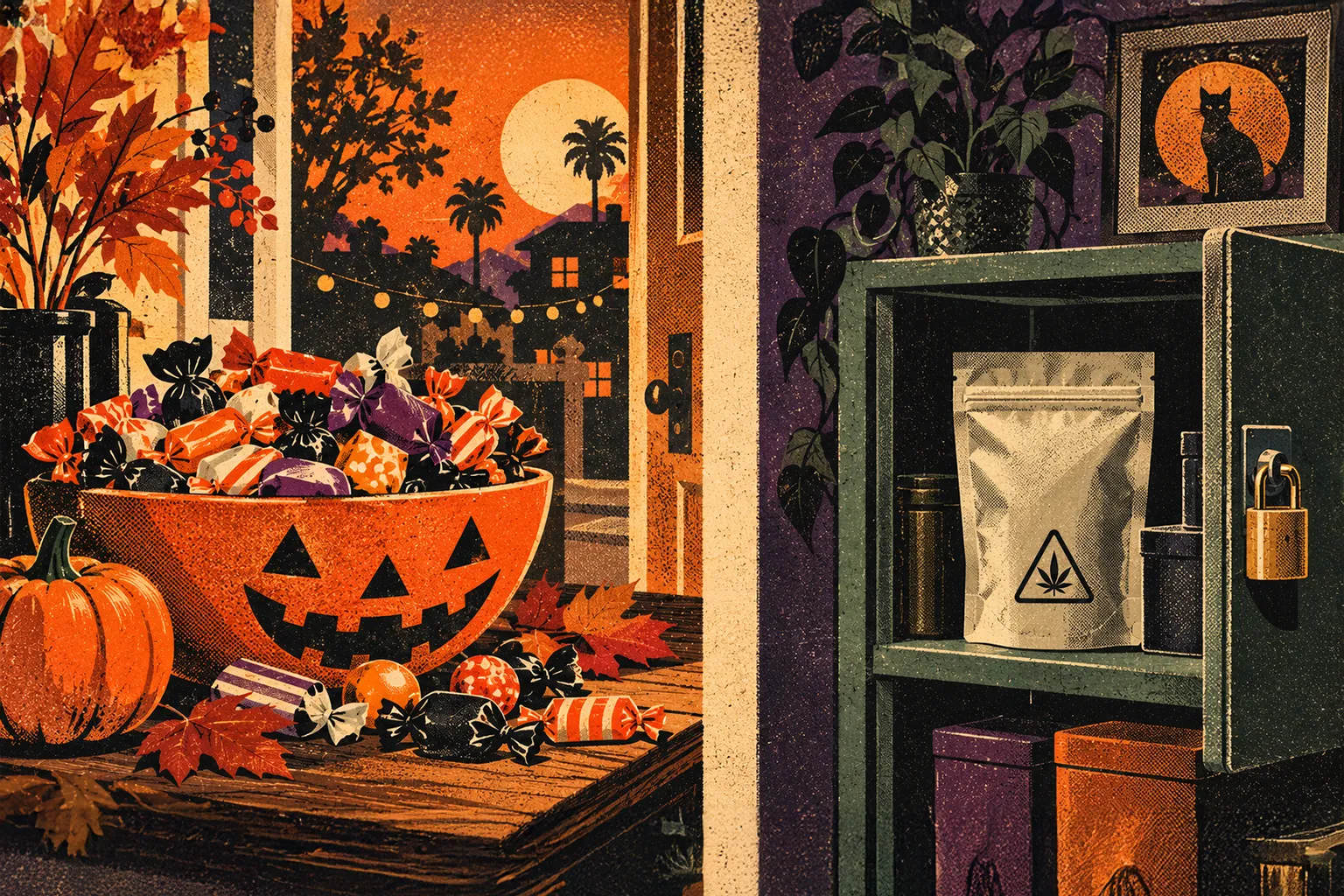
Halloween Cannabis Safety: How to Keep Edibles and Candy Separate
Halloween might be the one night of the year when having an unreasonable amount of candy sitting around the house feels completely normal.
For adults who also keep cannabis edibles at home, that creates an obvious problem: gummies, chocolates, chews, cookies, and other infused products can live in the same general visual world as ordinary sweets. To an adult who bought the product from a licensed dispensary, the difference is clear. To a child, guest, roommate, or anyone who does not know what is infused, it may not be.
California has strict rules designed to make legal cannabis products easier to distinguish and harder for children to access, but packaging can only do so much once the product enters someone’s home.
Halloween is a good excuse to talk about something that matters year-round: keeping cannabis clearly separated from ordinary food and making sure the people around you know exactly what is what.
Why Halloween Creates a Unique Edible Problem
Most of the year, a bag of candy on the kitchen counter is just a bag of candy.
During Halloween, candy can be everywhere.
There may be bowls near the front door, trick-or-treat bags on the floor, leftover chocolate in cabinets, party snacks on tables, and open packages being passed around throughout the evening. Add cannabis edibles to that environment and the opportunity for confusion increases.
That matters because edible cannabis does not always look unusual.
A gummy is still a gummy. Chocolate still looks like chocolate. A fruit chew does not announce its THC content once it has been removed from the package.
This is why the safest Halloween setup is also the simplest: ordinary candy and cannabis edibles should never be stored, displayed, or served together.
Not in the same bowl.
Not in neighboring unlabeled containers.
Not loose on the same table.
Creating physical separation removes much of the opportunity for a mistake before one can happen.
California Cannabis Packaging Is Designed to Reduce Confusion
Licensed cannabis products sold in California are subject to packaging and labeling requirements that do not apply to ordinary candy.
Cannabis goods must be sold in child-resistant packaging. Multi-serving edibles require packaging that maintains its child resistance throughout the life of the product, unless individual servings are themselves packaged appropriately.
Edible packaging must also be opaque, meaning consumers generally should not be able to see the edible through the package. California requires manufactured cannabis products to display the state’s universal cannabis symbol and clearly identify edible products as cannabis-infused.
The state also prohibits cannabis packaging from imitating products typically marketed to children and restricts product designs that could make an edible especially appealing or confusing to younger consumers.
Those requirements create an important visual boundary between regulated cannabis and ordinary snacks.
The boundary works best when consumers keep the product in the packaging that created it.
Keep Edibles in Their Original Packaging
Taking gummies out of a labeled cannabis package and transferring them into an ordinary candy jar eliminates many of the safeguards California requires.
The original package tells you what the product is, how much THC it contains, how many servings are inside, who manufactured it, and that the product contains cannabis. It also provides the child-resistant closure that the product was designed to use.
Once an edible is sitting loose in a plastic bag or food container, most of that information disappears.
That becomes especially risky during Halloween, when the house may already contain several visually similar sweets.
Keeping cannabis edibles in their original packaging is one of those small habits that solves several problems at once.
You know what the product is.
Other adults can recognize what it is.
The dosage information remains available.
And children have another barrier between themselves and the product.
Child-Resistant Does Not Mean Childproof
This distinction is important.
Child-resistant packaging is designed to make a package difficult for young children to open. It is not a guarantee that a child can never open it.
The safest approach is therefore to combine proper packaging with proper storage.
California public-health guidance recommends keeping cannabis locked away and out of the sight and reach of children and pets. On Halloween, that can mean moving edible products somewhere more secure than usual before guests arrive or trick-or-treating begins.
A high cabinet may be better than a countertop, but a locked location is better still.
The goal is not simply to make cannabis difficult to reach. It is to make sure nobody who should not have access to it has any reason to interact with it in the first place.
Never Put Cannabis Edibles in a Trick-or-Treat Bowl
This should be obvious, but Halloween safety is largely about removing opportunities for mix-ups.
Cannabis products should never be placed in a bowl, bag, or container used for trick-or-treat candy.
Even if the edible is still wrapped.
Even if you think you will remember which one is which.
Even if the cannabis product looks completely different from the candy you are handing out.
The easiest mistake to prevent is the one you never make possible.
Keep the trick-or-treat candy in one part of the house and cannabis products somewhere entirely separate.
What California’s THC Numbers Actually Mean
Legal cannabis edible labels contain information that is worth understanding before Halloween night, or any other night.
Under current California rules, a standard edible cannabis product may contain no more than 10 milligrams of THC per serving and no more than 100 milligrams of THC in the entire package. Certain medical-only products have separate rules.
That does not mean 10 milligrams is the right amount for every person.
Tolerance, experience, body size, metabolism, whether someone has eaten recently, other substances being used, and individual sensitivity can all affect the experience. A person who is comfortable with a particular amount may have a very different response than someone with little or no edible experience.
The serving information tells you how the product is portioned.
It does not tell you how your body will respond.
That distinction becomes particularly important with products containing multiple servings. A package may look like a single snack while actually containing several separate doses.
Read the label before eating, not afterward.
Edibles Do Not Work on the Same Timeline as Smoking or Vaping
One of the biggest differences between edible cannabis and inhaled cannabis is timing.
The effects of an edible can take considerably longer to appear. California cannabis labels specifically warn that intoxicating effects may be delayed for up to two hours, while public-health guidance notes that effects can also last longer than people expect.
That delay creates one of the most common pathways to overconsumption.
Someone eats an edible.
Twenty or thirty minutes pass.
Nothing seems to be happening.
They assume the first serving was not enough and take more.
Then both servings begin taking effect.
Halloween parties can make this easier to do because people are distracted, socializing, eating, moving around, and potentially consuming other substances. It becomes surprisingly easy to lose track of what was taken and when.
The smarter move is to know the serving amount, keep track of timing, and avoid repeatedly adding more simply because the effects have not arrived yet.
Keep Cannabis and Regular Candy Visually Separate
Original packaging is the first layer of protection, but organization matters too.
If you are hosting a Halloween gathering where adults may be consuming cannabis, create completely separate areas for ordinary food and cannabis products. Do not make guests guess.
A plate of ordinary brownies should not sit beside infused brownies that look nearly identical. Regular gummies and cannabis gummies should not share a serving tray. Infused chocolates should not be unwrapped and mixed into a dessert spread.
The issue is not only children.
Adults can accidentally consume cannabis too.
Someone who does not use cannabis, someone who plans to drive, or someone who simply assumes a piece of candy is ordinary food can have a very unpleasant night if the product is not clearly identified.
Good hosting means nobody has to wonder whether the snack in front of them contains THC.
Do Not Treat Homemade Edibles Like Ordinary Party Food
Homemade edibles introduce another layer of uncertainty because they do not come with the testing, standardized packaging, serving information, or labeling required of licensed California cannabis products.
Even when someone knows how much cannabis went into a recipe, distributing THC evenly across homemade food can be difficult.
One brownie may not necessarily contain exactly the same amount as the next.
If homemade infused food is present at an adult Halloween gathering, it should be clearly identified, physically separated from regular food, and inaccessible to anyone who should not consume it.
This is also one reason regulated products offer an important advantage for consumers who choose edibles: the package provides information about cannabinoid content and serving size that homemade food generally cannot provide with the same confidence.
Cannabis Should Never Become Part of a Halloween Prank
Halloween has a long tradition of jokes, tricks, mystery drinks, surprise foods, and intentionally confusing people.
Cannabis does not belong in that category.
Nobody should ever be given cannabis without knowing they are consuming it.
That means no secretly infused desserts, no swapping regular candy for infused candy, and no encouraging someone to eat something before telling them what is in it.
Consent matters with any intoxicating substance.
A Halloween joke ends quickly.
An edible can affect someone for hours.
What About Pets?
Children are not the only ones drawn to food left within reach.
Dogs in particular are very good at finding whatever humans hoped they would ignore. Chocolate, gummies, baked goods, and discarded wrappers can all become targets.
Cannabis products should be kept away from pets just as carefully as they are kept away from children.
California public-health guidance advises contacting the appropriate animal poison service if you believe a pet has ingested cannabis. The safest option, again, is prevention.
Halloween already brings unfamiliar people, open doors, decorations, candy, wrappers, and extra food into a home.
Cannabis should not become one more thing a pet has an opportunity to investigate.
If a Child Accidentally Eats Cannabis
Accidental cannabis ingestion can be particularly serious for children because of their smaller body size and increased sensitivity to THC.
Possible signs of cannabis poisoning can include unusual sleepiness, confusion, problems walking or sitting, nausea or vomiting, changes in heart rate, difficulty breathing, or unresponsiveness. Severe cases can require medical attention.
If a child may have consumed cannabis, California’s Department of Public Health recommends contacting California Poison Control at 1-800-222-1222 as soon as possible. The service is free, confidential, and available 24 hours a day.
If the situation appears to be an emergency, call 911.
Do not wait for Halloween night to look up that information if cannabis is kept in your home.
Knowing what to do is part of storing it responsibly.
Licensed Products Make the Rules Easier to Follow
Halloween also illustrates why the regulated cannabis market matters.
A legal California edible comes with required labeling, potency limits, packaging standards, testing, track-and-trace requirements, and a clear indication that the product contains cannabis.
Products from unlicensed sources may not provide those same assurances.
Packaging that deliberately imitates mainstream candy or snacks is an especially obvious warning sign. California specifically prohibits licensed cannabis products from imitating packaging commonly marketed to children.
If an infused product looks intentionally designed to make someone think it is a famous children’s candy or snack, that should not be mistaken for normal California dispensary packaging.
The legal market is designed to make cannabis recognizable as cannabis.
That distinction matters most when recognition becomes a safety issue.
Halloween Can Still Be Fun Without Making Cannabis Complicated
Cannabis safety does not require turning Halloween into a rulebook.
Most of it comes down to a handful of habits that make sense the rest of the year too.
Keep cannabis in its original package. Store it securely. Keep it away from children and pets. Do not mix it with ordinary candy. Know the serving size. Give edibles time to take effect. Make sure everyone consuming an infused product knows exactly what it is.
Halloween simply makes those habits more visible because the environment changes.
There is suddenly more candy around.
There are more people around.
And there are more opportunities for something to end up where it does not belong.
A little organization prevents most of the confusion.
Keeping Halloween Clearly Adult at Tropicanna
At Tropicanna, edibles are part of a regulated California cannabis market built for adults, with packaging and labeling designed to make that distinction clear.
Halloween does not change that responsibility once the product leaves the dispensary.
If you are picking up gummies, chocolates, beverages, or another edible from our Santa Ana menu this October, take a minute to read the package before you leave it in the cabinet. Know what is inside, understand the serving information, and decide where it will be stored before Halloween candy starts taking over the house.
The best cannabis safety usually is not complicated.
It is simply making sure everyone knows which treats are treats, and which ones are strictly for adults.