
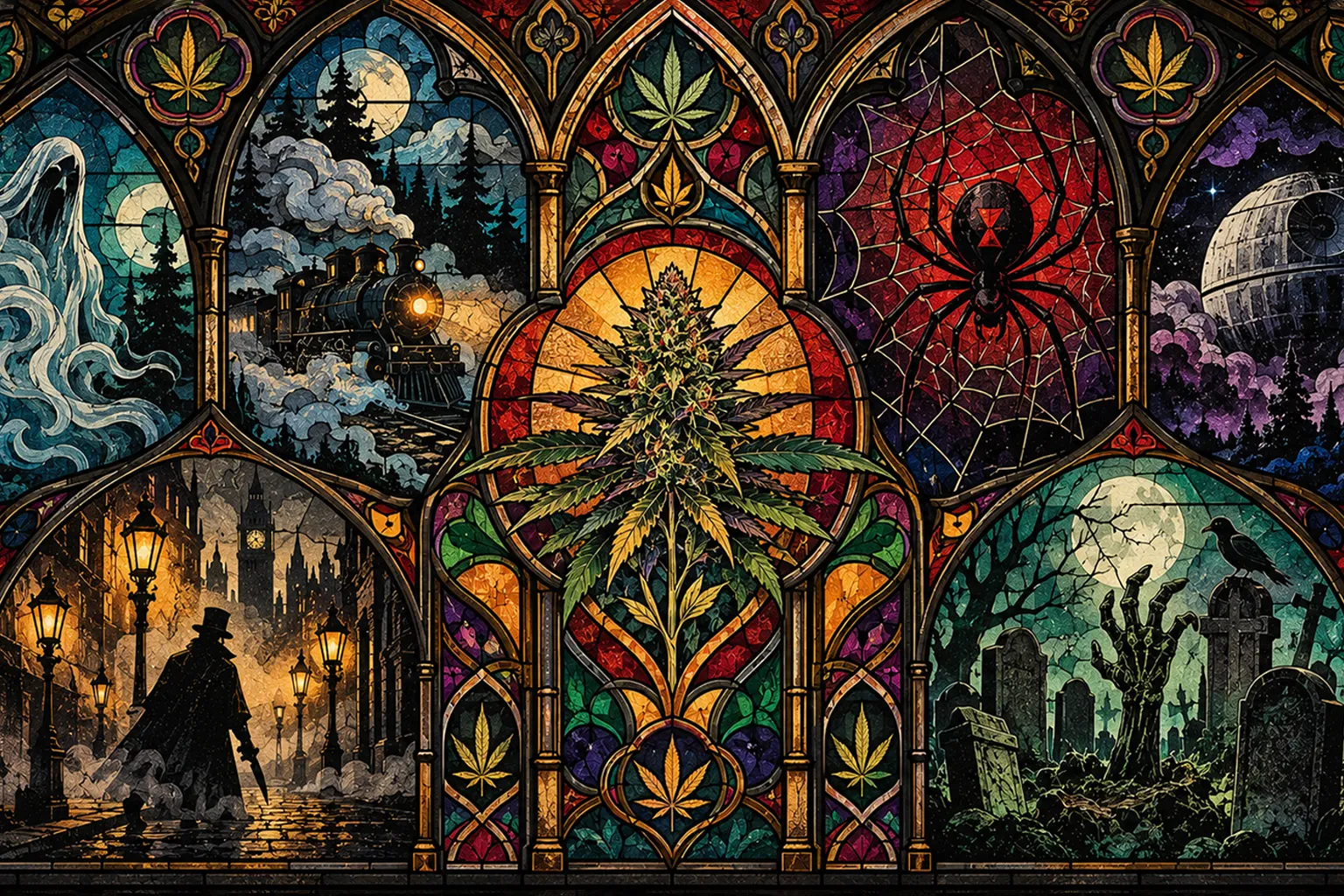
7 Famous Halloween-Inspired Cannabis Strains and the Stories Behind Their Names
Cannabis breeders have never been particularly interested in boring names.
Walk through enough dispensary menus and you eventually encounter cultivars named after desserts, celebrities, planets, weapons, animals, luxury products, inside jokes, fictional characters, and things that sound like they belong on the marquee of a midnight horror movie.
Halloween makes one corner of that naming culture especially noticeable.
Ghost OG. Zombie Kush. Black Widow. Jack the Ripper. Death Star. Ghost Train Haze.
The names sound like someone built a dispensary menu specifically for October, but their origins are far more interesting than simply choosing something spooky. Some came from old internet grow forums. Others evolved from breeder lineages, pop-culture references, or deliberate renaming. In a few cases, the genetics are much easier to document than the story behind the name itself.
That is part of the fun of cannabis history.
A cultivar name can become famous enough to outlive the circumstances that created it.
Why Cannabis Strain Names Get So Weird
Before legalization, cannabis naming developed without anything resembling a universal registry.
Breeders named their own work. Growers renamed cuts. Seeds moved between regions. Clones changed hands through informal networks. A memorable nickname could travel farther than reliable information about the plant itself.
That created a naming culture somewhere between agriculture, underground music, and streetwear.
Some names described aroma or appearance. Others referenced the parents used in the cross. Some honored the person or place associated with a particular cut. Others were clearly designed to be memorable.
And sometimes a good name simply stuck.
That history also explains why a strain name should never be treated as proof that two plants are genetically identical. Genetic research has found that samples carrying the same commercial cannabis name can sometimes be less closely related than consumers might expect.
So the stories below are best understood as histories of specific famous cultivars and the names associated with them, not evidence that every product carrying that name today represents exactly the same plant.
With that caveat out of the way, Halloween gives us the perfect excuse to dig into some of cannabis culture’s best spooky names.
Ghost OG: The Ghost Was Apparently a Person
Ghost OG might have the perfect Halloween strain name.
The funny part is that the “Ghost” may have had nothing to do with ghosts.
The cultivar belongs to the sprawling history of OG Kush, one of the most influential genetic families in modern California cannabis. Its origin story leads back to the early online cannabis communities of the late 1990s and early 2000s, particularly forums such as OverGrow and Cannabis World.
According to the story repeated across grower histories and supported by interviews with breeder ORGNKID, an OG Kush cutting was sold or passed to an online grower who used the handle Ghost.
That grower circulated the plant.
As more people received it, the cut became associated with his username.
Eventually, it became known as the Ghost cut, or Ghost OG.
In other words, one of the most supernatural-sounding names in cannabis may essentially mean “the OG Kush cut that came from the guy online named Ghost.”
That is almost more interesting than a deliberately spooky backstory.
It also captures how cannabis genetics moved during the pre-legal era. A plant could travel through internet forums, private gardens, medical-era dispensaries, and personal networks until the username attached to one exchange became part of cannabis vocabulary.
Ghost OG later became breeding material for numerous other cultivars.
Which brings us to an even more Halloween-appropriate descendant.
Ghost Train Haze: When a Famous Cut Became a Famous Hybrid
Ghost Train Haze sounds like the title of a forgotten supernatural western.
Its history is considerably easier to document.
Colorado breeder Rare Dankness created Ghost Train Haze #1 by crossing the original Ghost OG cut with Nevil’s Wreck.
The Ghost portion of the name therefore points directly back to Ghost OG.
Rare Dankness eventually created an entire Ghost Train series using different OG-family cuts crossed with Nevil’s Wreck, but Ghost Train Haze #1 became the standout. The breeder still identifies it as one of its most popular creations and notes its competition history, including a win at the 2014 High Times Cannabis Cup.
The interesting part is how names accumulate history.
Ghost Train Haze sounds like a single invented concept, but pull it apart and you begin uncovering layers of cannabis breeding history. The “Ghost” connects back to an old OG Kush clone and an internet handle. Nevil’s Wreck brings another breeding line into the picture. The finished name becomes something new while still carrying pieces of the plants that came before it.
That pattern happens constantly in cannabis.
A name becomes a miniature family tree.
Black Widow: The Other Name for a Cannabis Legend
Black Widow has one of the strongest documented naming stories on this list because it is tied directly to another legendary cultivar.
White Widow became one of the defining names of 1990s cannabis culture after its emergence in the Netherlands. Its reputation spread internationally, and versions of the name eventually appeared across numerous seed catalogs.
Breeder Shantibaba later left Green House Seed Company and became part of Mr. Nice Seedbank.
At Mr. Nice, the genetics he associated with the original White Widow breeding work appeared under a new name:
Black Widow.
Mr. Nice describes Black Widow as the original White Widow parentage, a Brazilian sativa crossed with a South Indian hybrid, renamed when Shantibaba brought the genetics to his new company.
That makes Black Widow different from a cultivar that simply borrowed a spooky name because it sounded good.
The darker name represented a new identity for already famous genetics.
It is also wonderfully suited to cannabis mythology. White Widow had already become iconic, and turning it into Black Widow gave essentially the same breeding history a more ominous second life.
Few rebrands in cannabis have ever sounded more appropriate for Halloween.
Jack the Ripper: A Dark Name Built Around Jack’s Cleaner
Some cultivar names make their inspiration fairly difficult to miss.
Jack the Ripper was created by influential breeder Subcool and TGA Genetics using Jack’s Cleaner and Space Queen.
The cultivar is commonly abbreviated JTR.
Jack’s Cleaner was already an important plant in Subcool’s breeding work, and Jack the Ripper was developed as a way of bringing those genetics into seed form by crossing the Jack’s Cleaner clone with a Space Queen male.
The naming connection appears to be a macabre play on the “Jack” already present in Jack’s Cleaner, transforming it into the name of one of history’s most infamous unidentified killers.
The exact moment Subcool settled on that name is not especially well documented in surviving breeder material, so it is better not to invent a more elaborate origin story than the evidence supports.
But the lineage itself is well established.
That distinction matters.
Cannabis history is filled with situations where we know exactly which plants went into a cross while knowing surprisingly little about the conversation that produced its name.
Jack the Ripper is a good example of how a breeder could take lineage information and turn it into something far more memorable than simply calling the plant “Jack’s Cleaner x Space Queen.”
Nobody forgets Jack the Ripper.
Chernobyl: Cannabis Breeding Goes Nuclear
Subcool’s catalog contained more than one cultivar with a dark name.
A few years after Jack the Ripper, TGA Genetics produced Chernobyl, another cultivar whose name sounds considerably more threatening than its citrus-heavy reputation might suggest.
Chernobyl was developed from a plant known as Bloodwreck, itself associated with Trainwreck and Trinity genetics, crossed with Jack the Ripper.
The plant became one of Subcool’s most recognized creations and was named High Times Strain of the Year in 2010.
Why exactly was it called Chernobyl?
That portion of the story is less clearly documented than the lineage.
The name is obviously taken from Chernobyl, the site of the catastrophic 1986 nuclear disaster in what is now Ukraine, but surviving descriptions of the cultivar tend to focus much more heavily on its breeding and characteristics than on a documented explanation from Subcool for choosing the name.
It fits a broader pattern in his breeding catalog, however.
Bloodwreck.
Jack the Ripper.
Chernobyl.
Subcool was not exactly naming everything after flowers and sunshine.
Cannabis breeding during that era often embraced provocative names because they were memorable, countercultural, and easy to distinguish from the increasingly crowded world of new hybrids.
Chernobyl certainly accomplished that.
Death Star: From Ohio Cannabis Culture to a Galaxy Far, Far Away
Death Star is another strain whose name feels tailor-made for a Halloween menu, even though its inspiration belongs more to science fiction than horror.
The cultivar is generally traced to Ohio and breeders known as Team Death Star, who worked with Sensi Star and Sour Diesel.
That lineage is one of the more consistently reported parts of Death Star’s history.
Accounts surrounding the name are more colorful.
One commonly repeated version says the breeders had been working with Sour Diesel after encountering East Coast genetics and eventually crossed it with Sensi Star. The resulting plant developed a reputation within their circle for unusually heavy potency. According to one historical account preserved by a modern cultivator working with the genetic, people began referring to it simply as “the death,” while the breeders themselves were known as Team Death Star.
The obvious pop-culture reference needs little explanation.
The Death Star is the planet-destroying space station from Star Wars.
Cannabis names frequently borrow language from movies, music, comics, and other pieces of popular culture, and this one eventually became much bigger than a private joke among breeders.
By the 2000s and 2010s, Death Star had become a recognizable name far outside Ohio.
That journey from a regional breeder project to a nationally familiar cultivar is another recurring theme in cannabis genetics.
Once a clone develops a reputation, the name can travel almost as aggressively as the plant.
Zombie Kush: A Halloween Name With Serious Breeding Behind It
If someone invented a cannabis strain specifically for an October blog, Zombie Kush would be suspiciously perfect.
But the cultivar has a documented breeding history behind the name.
Spanish breeder Ripper Seeds traces Zombie Kush back to an early breeding project involving an old Lavender Kush clone and Amnesia. From that work came a selected plant known as Sideral, which was later crossed with Bubba Kush.
The result became Zombie Kush.
Ripper Seeds has continued working the line and describes it as one of the most awarded cultivars in its catalog.
What the breeder does not clearly document is why the word “Zombie” was chosen.
And that is worth saying directly.
It is tempting when writing about cannabis history to turn every strain name into a neat origin story. If the breeder has never publicly explained the name, the responsible answer is sometimes simply that the genetics are documented and the naming decision is not.
Zombie Kush still tells us something useful about cannabis culture.
By the time it emerged, Kush had become one of the most recognizable words in cannabis. Adding a distinctive modifier was a way for breeders to give their own work an identity inside an increasingly crowded genetic category.
Zombie Kush definitely has an identity.
You are unlikely to confuse the name with anything else.
Why Do So Many Cannabis Names Sound Like Horror Movies?
There is a practical reason unusual cannabis names survive.
They are memorable.
Breeders work in an environment where thousands of crosses exist and countless products compete for attention. A distinctive name gives a plant a better chance of being remembered, discussed, requested, traded, and eventually preserved.
That was arguably even more important before modern legal branding.
A breeder did not necessarily have professional packaging, paid advertising, polished photography, or a social media strategy.
The cultivar itself was the brand.
Names such as Ghost OG, Jack the Ripper, Death Star, and Zombie Kush create imagery immediately. You can hear the name once and probably remember it later.
Cannabis culture also grew from communities that historically existed outside mainstream commercial agriculture. Underground music, skate culture, graffiti, science fiction, horror, psychedelia, internet forums, and counterculture all influenced the language surrounding the plant.
Nobody expected cannabis genetics to sound like tomato cultivars.
The strange names became part of the culture.
A Great Name Does Not Prove a Great Genetic
This is where the fun history runs into modern cannabis reality.
A recognizable strain name does not guarantee that every product carrying that name represents the original genetics.
Research has repeatedly shown that commercial cannabis naming can be inconsistent. Samples carrying identical names have sometimes shown meaningful genetic or chemical differences, while differently named products can occasionally be surprisingly similar.
That does not make strain names meaningless.
It means provenance matters.
Who bred it?
Who selected the phenotype?
Is it seed-grown or a preserved clone?
Where did the producer obtain the genetics?
How closely does today’s version connect to the cultivar that originally made the name famous?
Those questions become especially important with older cannabis names that have spent decades moving through informal networks.
Our recent look at What Makes a Cannabis Genetic “Stable”? explored the same issue from the breeding side. A name can describe a family, a cross, a particular clone, or sometimes simply what a producer decided to call a plant.
The name is the beginning of the story.
It is not the entire story.
The Best Cannabis Names Become Cultural Artifacts
There is something uniquely cannabis about the fact that a username on an early internet forum can eventually become the name of a famous genetic.
Or that a breeder can turn Jack’s Cleaner into Jack the Ripper.
Or rename White Widow as Black Widow and create another legendary name in the process.
These names preserve pieces of the culture that produced them.
Some contain breeder history.
Some contain lineage clues.
Some contain jokes nobody remembers anymore.
Others are pieces of pop culture permanently attached to a plant.
And a few remain mysteries.
That uncertainty is not necessarily a flaw. Cannabis spent most of its modern breeding history without the documentation systems we expect from established agricultural crops. Much of the culture was carried person to person, clone to clone, seed to seed, and eventually forum post to forum post.
The names became part of the archive.
Finding the Story Behind the Name at Tropicanna
A dispensary menu gets more interesting when you know there can be decades of history hiding behind a few words.
A familiar name like Ghost OG might lead back to the early internet cannabis community. Another cultivar may carry the work of a breeder who spent years selecting a particular genetic line. A modern cross may contain several famous names stacked together through generations of breeding.
That is why we pay attention to more than strain names at Tropicanna.
The producer, breeder, lineage, cultivation, and specific expression of the plant all help explain what is actually inside the jar.
This October, the spooky names are an easy place to start digging.
Because in cannabis, sometimes the strangest thing about a strain is not what someone decided to call it.
It is the story of how that name survived.