
The Rise of Living Soil: A New Approach to Growing Premium Cannabis
For most cannabis consumers, the soil disappears the moment the flower reaches the jar.
The label tells you the strain, THC percentage, package size, grower, and sometimes terpene information. It might tell you whether the flower was grown indoors or under the sun. What it usually does not explain is what was happening beneath the plant during the months before harvest.
For a growing group of cultivators, that underground environment has become one of the most important parts of the entire process.
The approach is usually described as living soil.
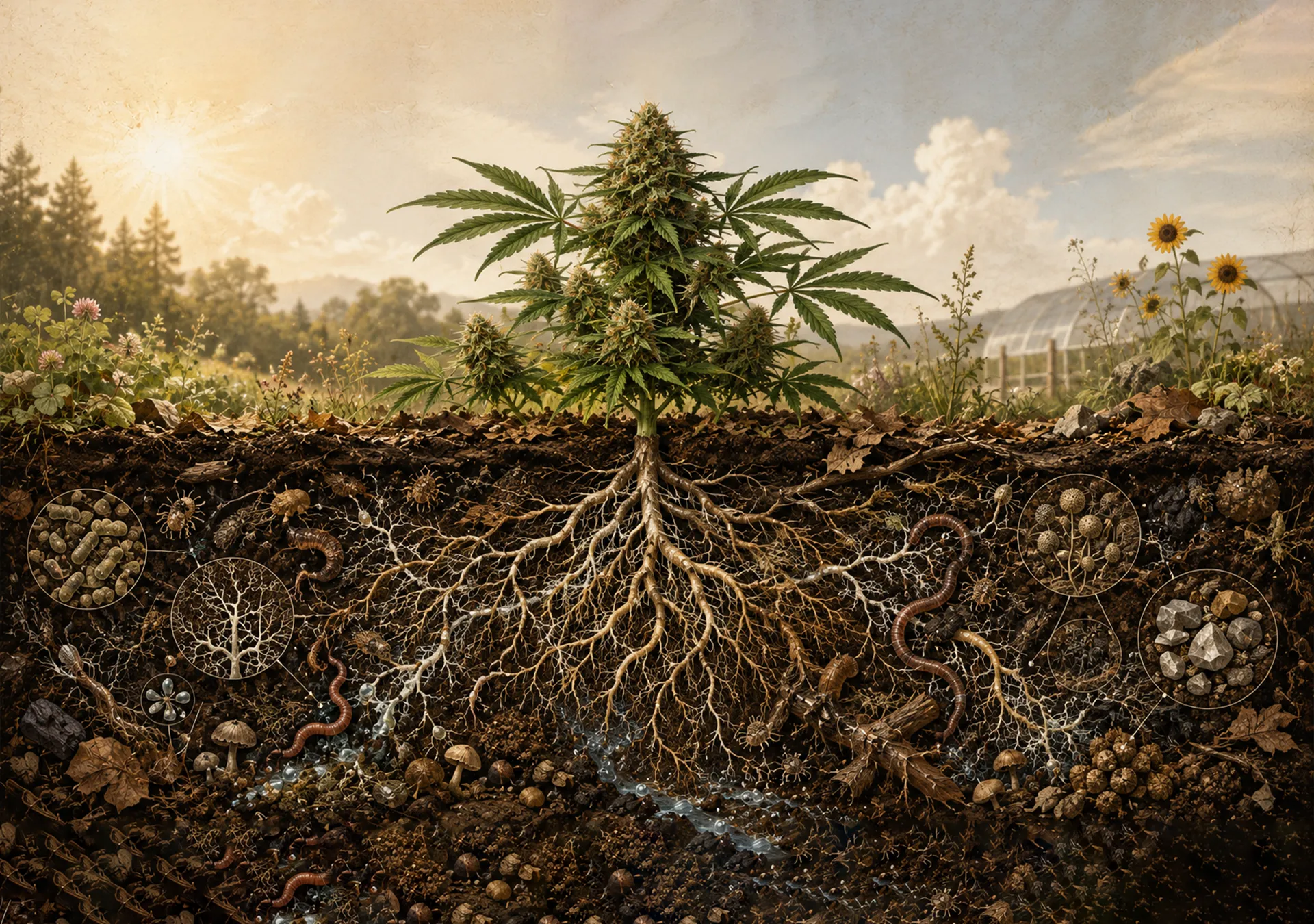
Instead of treating the root zone primarily as a place to hold a plant while nutrients are delivered through irrigation, living soil cultivation attempts to maintain a biologically active ecosystem around the roots. Bacteria, fungi, protozoa, nematodes, worms, organic matter, minerals, plant roots, and other organisms interact as part of a larger soil food web.
The concept is much older than legal cannabis. Farmers and soil scientists have studied biological soil systems for generations, and modern agricultural research increasingly describes healthy soil as a living ecosystem rather than an inert growing medium.
Cannabis is now bringing that philosophy into one of the most technically controlled crops in modern agriculture.
Some outdoor farms are applying regenerative agricultural principles directly in the earth. At the other end of the spectrum, highly sophisticated indoor cultivators are building living soil beds beneath artificial lights and climate-controlled rooms.
Even 710 Labs, one of California’s most recognizable premium flower and solventless brands, currently says living soil makes up roughly 25% of its garden.
That tells you how far the idea has traveled.
Living soil is no longer limited to small outdoor farms or gardening forums. It has become part of the conversation about how premium cannabis can be cultivated at a commercial level.
The more interesting question is what it actually means.
Soil Was Never Really Just Dirt
Healthy soil is extraordinarily complex.
The USDA describes healthy soil as a living ecosystem filled with organisms that help decompose organic material, cycle nutrients, influence soil structure, manage water, and interact with plant roots.
The area immediately surrounding a plant’s roots is known as the rhizosphere, and it can contain an especially active microbial community. Roots release compounds into that environment while microorganisms interact with plant material and organic matter around them.
Those relationships affect how nutrients move through the soil.
Conventional and soilless cultivation systems can supply plants with precisely formulated nutrients through irrigation. That approach gives growers tremendous control over what the crop receives and has helped make modern indoor cannabis remarkably productive.
Living soil approaches the root zone differently.
Rather than supplying nearly everything directly in a readily available form, growers attempt to maintain a biological system that helps break down organic material and cycle nutrients within the soil.
The plant is still being cultivated intentionally.
The grower is simply managing an ecosystem in addition to the plant itself.
What Does “Living Soil” Actually Mean?
There is no single universal cannabis recipe that defines living soil.
One cultivator might use large indoor beds filled with amended soil and reuse them for harvest after harvest. Another might grow outdoors directly in native soil while using compost, cover crops, mulch, and minimal disturbance. Others use containers containing biologically active soil mixtures that are maintained and amended between cycles.
The common philosophy is that the soil itself is treated as something worth preserving.
Instead of viewing the growing medium as disposable, cultivators may build organic matter, encourage biological activity, reuse soil, maintain living roots, add compost or worm castings, use mulch, and introduce mineral or plant-based amendments depending on the needs of the system.
The exact methods vary enormously.
That is important because living soil describes an approach to cultivation, not one standardized production system.
Seeing the words on a package should create questions.
It should not automatically answer all of them.
Living Soil Is Not the Same as Organic
Cannabis terminology can get confusing quickly because living soil, organic, no-till, and regenerative are often used together.
They are related concepts, but they are not interchangeable.
Living soil generally refers to maintaining a biologically active soil ecosystem. No-till describes reducing or eliminating physical tillage. Regenerative agriculture is a broader agricultural philosophy that can incorporate soil health, biodiversity, erosion prevention, living roots, water management, habitat, and long-term ecosystem health.
Certification is another issue entirely.
California has a cannabis certification program called OCal, which establishes standards comparable to the USDA National Organic Program. Cannabis products meeting those requirements can carry the OCal designation.
That is different from a company simply describing a cultivation method as organic or living soil.
A useful distinction is simple:
Living soil is a cultivation approach. OCal is a certification standard.
Consumers should not assume the presence of one automatically guarantees the other.
Why Cannabis Moved Away From Soil in the First Place
To understand the renewed interest in living soil, it helps to understand why highly controlled cannabis cultivation became so popular.
Prohibition pushed generations of growers indoors.
Once plants moved inside, cultivators gained control over variables outdoor farmers could never completely control. Lighting schedules could be manipulated. Temperature and humidity could be adjusted. Harvests could happen throughout the year. Specific female plants could be preserved through cloning.
The root zone became more controlled too.
Cannabis can be successfully cultivated in coco coir, rockwool, peat-based substrates, hydroponic systems, and other growing media where nutrients are precisely delivered through irrigation.
For commercial growers, that precision can be extremely valuable.
Inputs can be measured.
Nutrient recipes can be standardized.
Irrigation can be automated.
Individual rooms can follow carefully designed schedules.
Problems can sometimes be identified quickly by analyzing what is entering and leaving the root zone.
Living soil does not prove those systems wrong.
It represents another approach.
Instead of asking how precisely the cultivator can feed the plant, living soil asks how effectively the cultivator can build an environment in which the soil helps participate in that process.
710 Labs Shows Living Soil Can Be High-Tech
The phrase “living soil” can create an image of a cannabis plant growing outdoors on a small regenerative farm somewhere in Northern California.
That certainly exists.
But one of the most interesting developments is the use of living soil inside sophisticated indoor cultivation facilities.
710 Labs provides a strong current example.
The company says living soil currently represents about 25% of its garden. Those rooms use biologically active soil containing worms and mycelium, and 710 Labs describes the system as hand-watered, organically managed, and no-till.
The company also acknowledges the commercial tradeoff.
Its living soil rooms operate on longer cultivation cycles and produce fewer harvests each year. 710 Labs says those and other factors can make the resulting batches more expensive.
That is an important detail because it moves the conversation beyond marketing.
The company is not claiming that living soil is simply an easier way to grow.
It is choosing to dedicate part of a controlled indoor facility to a system that can require more time.
That makes 710 Labs particularly useful for understanding where the movement is heading.
Artificial lighting is still being used.
Environmental conditions are still controlled.
Genetics are still selected carefully.
The flower is still produced within a highly technical commercial operation.
The difference is that beneath some of those plants is a biological system the cultivator is trying to preserve rather than replace.
Nature and technology are not necessarily competing.
They can exist in the same room.
Living Soil Can Continue Into the Hash Jar
710 Labs also demonstrates why cultivation method can matter beyond flower.
The company is best known among many cannabis enthusiasts for solventless concentrates, and it has released products specifically identified as coming from living soil cultivation, including Living Soil Persy Badder.
That creates an interesting connection between what happens around the roots and what eventually reaches the concentrate jar.
Solventless hash is essentially a process of separating and collecting the resin glands produced by the plant. Cultivators therefore have strong incentives to grow plants capable of producing abundant, desirable resin before a hashmaker ever begins washing or pressing the material.
For a company such as 710 Labs, cultivation and extraction are closely connected.
The living soil itself does not make rosin.
It creates one possible environment for producing the plant whose resin eventually becomes rosin.
That distinction is important because excellent solventless products still depend on genetics, resin characteristics, harvest timing, freezing, washing, pressing, storage, and the skill of the people handling the material.
Living soil becomes one part of a much larger quality system.
No-Till Is Closely Connected to the Idea
Living soil cultivation is frequently associated with no-till farming.
Tillage means physically turning or disturbing soil. Traditional agricultural systems may till fields to prepare for planting, manage weeds, or incorporate material into the ground.
That disturbance can also alter soil structure and disrupt organisms living within it.
Modern soil-health programs increasingly encourage minimizing disturbance when appropriate. The USDA identifies reduced disturbance as one of its core soil-health principles, alongside maintaining soil cover, biodiversity, and continuous living roots.
A no-till cannabis grower attempts to disturb the soil as little as practical between harvests.
After a cannabis plant is removed, portions of the root system may remain in the bed and gradually decompose. The next plant can be placed into the same soil while organic matter and amendments are used to maintain the system.
Over multiple cycles, the bed becomes infrastructure rather than something thrown away after every harvest.
No-till and living soil often work together.
They are still not exactly the same thing.
A soil can contain active biological life without being managed under a strict no-till system, while no-till alone does not tell you everything about how the crop is fertilized, irrigated, or grown.
Cover Crops Keep Roots in the System
Some living soil gardens look unusual because cannabis is not the only plant growing in the bed.
The vegetation beneath the canopy may be intentional.
Cover crops have been used in agriculture long before cannabis growers adopted them. Depending on the species and growing system, cover crops can protect the soil surface, add organic matter, support biodiversity, reduce erosion, improve soil structure, and help maintain living roots.
Living roots are particularly important to the biological philosophy behind healthy soil.
Plants release carbon compounds through their roots that can support organisms living in the rhizosphere. Maintaining plant life in the soil therefore helps maintain biological activity between or around primary crops.
Cannabis growers may use clovers, grasses, legumes, or other low-growing plants as part of a cover-crop mixture.
The cannabis plant remains the commercial crop.
It does not have to be the only living plant contributing to the soil system.
Mulch Protects What Is Happening Below
Living soil beds often have another noticeable feature.
The soil may be covered.
Straw, leaves, chopped plant material, or other organic matter can form a layer of mulch across the surface.
In outdoor agriculture, maintaining soil cover can reduce erosion, evaporation, and temperature extremes while providing habitat and organic material for soil organisms.
Some of those same principles translate indoors even when wind and rain are no longer major concerns.
A covered soil surface can lose moisture more slowly and provide additional material that eventually becomes part of the biological system as it breaks down.
To someone accustomed to a clean container of coco or rockwool, the bed can look messy.
To the living soil grower, much of that apparent mess is infrastructure.
Worms Become Part of the Cultivation System
Then there are the worms.
710 Labs specifically mentions worms in its living soil rooms, and they appear frequently in other biologically managed cultivation systems as well.
Earthworms consume decomposing organic material and help process it through the soil. Their movement can affect soil structure, and the castings they produce contain biologically active organic matter.
This is also why worm castings, or vermicompost, are common ingredients in living soil recipes.
Some growers introduce prepared castings.
Others maintain worms directly inside large beds.
Either way, the philosophy represents a major shift from conventional nutrient management.
The cultivator is not thinking only about what the cannabis plant needs.
They are maintaining conditions that allow an entire biological community to function around it.
The Soil Food Web Is Doing Work You Cannot See
The phrase soil food web describes the network of organisms living and interacting within soil.
Bacteria and fungi help break down organic materials.
Protozoa and nematodes interact with microbial populations.
Earthworms and arthropods process larger pieces of organic matter.
Roots release compounds into the rhizosphere while microorganisms participate in nutrient cycling and other biological processes.
Much of this activity happens at a scale the customer will never see.
That can make living soil difficult to market responsibly.
The temptation is to simplify a complicated biological system into a promise that the weed will automatically taste better.
The science is more interesting than that.
Living soil changes the environment in which the plant is growing.
How successfully that environment translates into flower still depends on many other decisions.
Cannabis Research Is Starting to Look Underground
Scientific research into cannabis cultivation is expanding, and researchers are increasingly studying the relationship between the plant and the organisms around its roots.
A 2024 study examining Cannabis sativa seedlings found that both soil and seed influenced bacterial diversity within the plants themselves. The researchers found that changing the soil environment altered the bacterial communities associated with the cannabis seedlings.
Another 2024 study examining cannabis grown outdoors found that organic biostimulant treatments affected soil microbial activity and several measures related to plant productivity under the conditions tested.
Research published in 2025 also examined how soil quality influenced cannabinoid and terpenoid composition in two hemp cultivars. The results showed that soil conditions could influence chemical expression, but importantly, the effects differed depending on the cultivar.
That last point matters.
The relationship is not as simple as “better soil equals more THC” or “living soil equals more terpenes.”
Plants respond differently.
Genetics still matter.
Environment still matters.
Cultivation is a system of interacting variables.
Does Living Soil Produce Better Cannabis?
This is the question consumers are naturally going to ask.
The most accurate answer is:
It can produce exceptional cannabis. That does not mean it automatically does.
Living soil growers frequently describe stronger aromatic expression, richer flavor, or more complex flower coming from biologically managed soils.
There are plausible reasons cultivation environment could influence the chemistry of the plant, and research increasingly supports the broader idea that soil conditions and plant microbiomes matter.
But there is not enough evidence to declare living soil universally superior to every other cannabis cultivation method.
Cannabis quality depends on genetics, phenotype selection, lighting, temperature, humidity, irrigation, plant health, nutrition, harvest timing, drying, curing, trimming, storage, and freshness.
A skilled hydroponic cultivator can grow exceptional flower.
A poorly managed living soil garden can grow disappointing flower.
The cultivation method deserves attention.
It should never receive a free pass.
Living Soil Does Not Automatically Mean More THC
This is particularly important in a cannabis market that loves numbers.
There is no responsible reason to tell consumers that living soil automatically produces higher THC.
Research examining soil quality and cannabinoid production has shown more complicated relationships, including different responses between cultivars.
Higher THC is also not synonymous with higher quality.
A plant could test extremely high and still have poor aroma, weak flavor, bad cure, or disappointing freshness.
Living soil is therefore most interesting when it gets consumers to move beyond the single-number view of cannabis.
Instead of asking only how much THC the flower contains, people begin asking how the plant was cultivated in the first place.
That is a much more useful conversation.
It Does Not Automatically Mean More Terpenes Either
The same caution applies to terpene claims.
Cannabis marketing frequently implies that living soil creates more terpenes.
The evidence does not justify making that statement universally.
Soil conditions can influence the chemical expression of plants, including terpenoid composition. However, the magnitude and direction of those changes can depend heavily on genetics and growing conditions.
A living soil cultivar with strong genetic potential for aromatic expression may perform beautifully.
Another cultivar may respond differently.
The environment can influence expression.
The genetics still establish much of what is possible.
That is why the most credible living soil growers tend to talk about the entire cultivation system rather than promising a guaranteed terpene percentage.
Genetics Still Set the Potential
A living soil bed cannot create characteristics a plant does not have the genetic capacity to express.
If a cultivar has limited resin potential, microbes cannot magically turn it into an elite hash plant.
If the genetic aroma is relatively subdued, soil biology cannot simply invent an entirely different aromatic identity.
Cultivation determines how successfully genetic potential is expressed.
The genetic potential has to exist first.
This is especially relevant for companies like 710 Labs.
A cultivation method matters, but so does selecting genetics capable of producing the resin and aromatic characteristics the company wants for flower and solventless extraction.
Living soil is the environment.
Genetics still provide the blueprint.
The Grower Still Matters Most
There is a tendency in cannabis to look for one variable that explains quality.
High THC.
High terpene percentage.
Indoor.
Sungrown.
Organic.
Living soil.
Hand trimmed.
None of them works alone.
Excellent cannabis usually comes from a long chain of good decisions.
The grower has to choose the right genetics, understand the phenotype, create the appropriate environment, keep the plant healthy, harvest at the right point, dry carefully, cure properly, protect the trichomes, package the flower well, and get it to the consumer before its best characteristics disappear.
Living soil adds another layer of complexity to that chain.
It does not replace the chain.
Managing a Living System Requires Skill
Living soil can occasionally be described as if nature does all the work once the bed is built.
Commercial cultivation is not that simple.
Nutrient availability still matters.
Soil moisture still matters.
Oxygen around the roots matters.
Environmental conditions still matter.
Pests and diseases still exist.
Organic amendments can release nutrients at different rates.
Microbial populations change.
The bed may accumulate imbalances when it is poorly managed.
Even watering becomes a specialized skill.
Too much water can reduce oxygen around the roots. Too little can stress the cannabis plant and the biological system the grower is trying to maintain.
The grower is trading some direct control for biological complexity.
For skilled cultivators, that trade can be worthwhile.
For other commercial environments, a precisely managed soilless system may make considerably more sense.
There is no single correct way to grow excellent cannabis.
Living Soil Has Commercial Tradeoffs
710 Labs is unusually transparent about this part.
Its living soil rooms use longer growing cycles and produce fewer harvests each year. The company acknowledges that these and other factors contribute to higher prices for some living soil batches.
That is important because agriculture is still a business.
A cultivation technique can produce flower a grower loves while creating difficult economics at commercial scale.
Longer cycles mean fewer harvests.
Hand watering requires labor.
Maintaining biological beds can require space and attention.
Large soil beds cannot necessarily be changed as quickly as disposable media if the cultivation team decides to redesign the system.
For premium brands, those tradeoffs may be acceptable if the finished product justifies them.
For value-focused cannabis, the economics may be harder.
Cultivation philosophy always has to meet commercial reality eventually.
Reusing Soil Changes the Waste Equation
One of the strongest practical arguments for living soil has little to do with potency or flavor.
It involves reuse.
Many cultivation systems depend on growing media that are replaced after a production cycle. Depending on the facility, that can involve bags, blocks, pots, substrates, and other materials that eventually have to be removed or processed.
Large living soil beds approach the root zone more like infrastructure.
The cultivator builds the soil and attempts to maintain it over multiple harvests.
Roots can decompose.
Organic matter can return.
Cover crops can continue growing.
Amendments can replenish nutrients.
Biological communities can continue developing.
710 Labs specifically describes the microbial diversity of its living soil increasing over time.
That does not make indoor living soil cultivation environmentally perfect. A controlled indoor garden can still require significant electricity for lighting, HVAC, dehumidification, and other equipment.
But reusable soil changes one part of the production model from replacement toward maintenance.
That is meaningful.
Regenerative Cannabis Goes Beyond Living Soil
Living soil also connects naturally to the larger movement around regenerative cannabis cultivation.
Regenerative agriculture generally thinks beyond producing the crop itself. Farmers may focus on soil health, biodiversity, living roots, reduced disturbance, water conservation, erosion prevention, habitat, and the long-term health of the surrounding agricultural ecosystem.
Those ideas become especially visible in outdoor cannabis.
Northern California farms certified through programs such as Sun+Earth use practices including living soil, cover crops, composting, minimized disturbance, biodiversity, and other regenerative techniques.
The farm becomes part of the product story.
But regenerative agriculture and indoor living soil are not identical.
An indoor bed beneath LEDs cannot recreate an outdoor farm ecosystem.
An outdoor regenerative farm does not have the environmental control of an indoor room.
Both can still apply some of the same underlying principles to soil biology.
That is one of the reasons living soil has become such an interesting meeting point between different cannabis traditions.
California Is a Natural Home for Living Soil
California cannabis has always existed between agriculture and technology.
Northern California developed a deep culture of outdoor farming, genetic preservation, and cultivation tied closely to the land.
Southern California became known for highly controlled indoor flower grown in warehouses and sophisticated cultivation facilities.
Living soil allows those two philosophies to overlap.
Outdoor farmers can apply regenerative principles directly to the land.
Indoor cultivators can bring soil beds, worms, microbial ecosystems, organic amendments, and no-till practices into climate-controlled rooms.
710 Labs is particularly interesting because it demonstrates that living soil does not require rejecting modern cultivation technology.
The lights stay.
The environmental controls stay.
The technical cultivation knowledge stays.
The soil becomes the biological component inside that controlled system.
That combination feels particularly suited to California cannabis, where growers have spent decades taking ideas from completely different agricultural traditions and finding ways to combine them.
Living Soil Is Becoming Part of Brand Identity
Cultivation methods were once largely invisible to cannabis customers.
Most people wanted to know the strain and perhaps whether it was indoor or outdoor.
Then THC percentage became dominant.
As consumers became more knowledgeable, the questions expanded.
Who grew it?
What genetics are behind it?
When was it packaged?
Was it hand trimmed?
Was it grown under the sun?
Was it grown in living soil?
Is it OCal certified?
Does the farm practice no-till or regenerative agriculture?
Brands have recognized that interest.
No Till Kings has built its entire premium indoor flower identity around living soil and OCal-certified cultivation. Regenerative outdoor farms have made soil health central to their story. 710 Labs now publishes educational material explaining why part of its garden uses living soil and identifies certain products specifically as living soil batches.
That is a major shift.
The root zone has become consumer-facing information.
The Label Still Has to Earn Your Trust
This is where consumers should remain skeptical.
Cannabis marketing loves terminology that sounds like quality.
Craft.
Small batch.
Premium.
Exotic.
Organic.
Regenerative.
Living soil.
Some of those words can describe meaningful production differences.
None of them tells you everything about the flower.
Living soil cannabis should still be judged as cannabis.
How fresh is it?
Who grew it?
What genetics are behind it?
Does the aroma match what the cultivar should express?
How was it cured?
Does the flower feel properly stored?
Does the product justify its price?
A cultivation method can give a customer another reason to investigate a product.
The finished flower still has to close the argument.
Why the Living Soil Movement Matters
Not every cannabis customer is going to search specifically for living soil flower.
They do not have to.
The larger value of the movement is that it is encouraging people to think about cannabis as agriculture again.
For years, the legal market became increasingly focused on packaging, potency, branding, discounts, and product formats.
Living soil brings attention back underground.
What is happening around the roots?
Can growing media be reused?
What role do microorganisms play?
How much disturbance does the soil experience between cycles?
Are living roots being maintained?
How are nutrients cycled?
How much of the cultivation system is being thrown away after every harvest?
Those are useful questions even when growers reach different conclusions about the best answers.
Cannabis spent decades becoming more controlled.
Living soil is showing that biological complexity can have a place inside that control.
You Do Not Have to Choose a Side
Cannabis cultivation debates have a tendency to become tribal.
Indoor versus outdoor.
Sun versus lights.
Organic versus conventional.
Soil versus hydroponics.
Living soil versus bottled nutrients.
Those comparisons can be interesting, but they are rarely as simple as the argument makes them sound.
Exceptional cannabis can come from different systems.
The right cultivation method depends on the genetics, facility, climate, scale, business model, grower, and type of product being produced.
The rise of living soil does not mean hydroponics failed.
It means some cultivators believe there is value in putting biological complexity back into the root zone.
710 Labs choosing to dedicate roughly a quarter of its garden to living soil while continuing to operate other cultivation systems may actually be one of the best examples of that balance.
There does not have to be one winner.
There has to be good cannabis.
Why Living Soil Matters at Tropicanna
The more someone learns about flower, the harder it becomes to judge cannabis using THC percentage alone.
Genetics matter.
The cultivation team matters.
Freshness matters.
Harvest timing matters.
Drying and curing matter.
Storage matters.
And increasingly, consumers are learning to ask what happened around the roots before any of those later steps began.
That is why living soil is worth understanding.
At Tropicanna, our goal is not to convince every customer that one cultivation method is automatically better than another. It is to give Orange County cannabis consumers access to enough quality growers, genetics, price points, and cultivation philosophies that they can learn what actually matters to them.
710 Labs is a perfect example of why that variety is valuable. The company currently uses living soil for only part of its garden, not everything it grows, while applying the method to selected premium flower and solventless production. 710 Labs also currently lists Tropicanna among its key California retail partners, giving our customers a direct connection to a producer actively experimenting with this style of cultivation.
Other cultivators may reach exceptional results through completely different systems.
That is what makes a well-curated cannabis menu interesting.
Instead of stopping at “Which one has the highest THC?” customers can start asking better questions.
Who grew it?
What genetics are behind it?
How was it cultivated?
How fresh is the batch?
What makes this grower different?
And after all of that, does the cannabis actually deliver?
Living soil may be growing beneath the surface, but the larger shift is happening above it.
California consumers are becoming more interested in the decisions that create great flower, and the better those questions become, the better cannabis culture becomes with them.