
What Makes Cannabis Flower Frosty? A Closer Look at Trichomes
Some cannabis flower seems to sparkle before the jar is even opened.
Under the right light, the surface can look dusted with sugar, coated in tiny crystals, or almost metallic. Other flower may appear smooth, leafy, or comparatively dull, even when its laboratory results show similar cannabinoid levels.
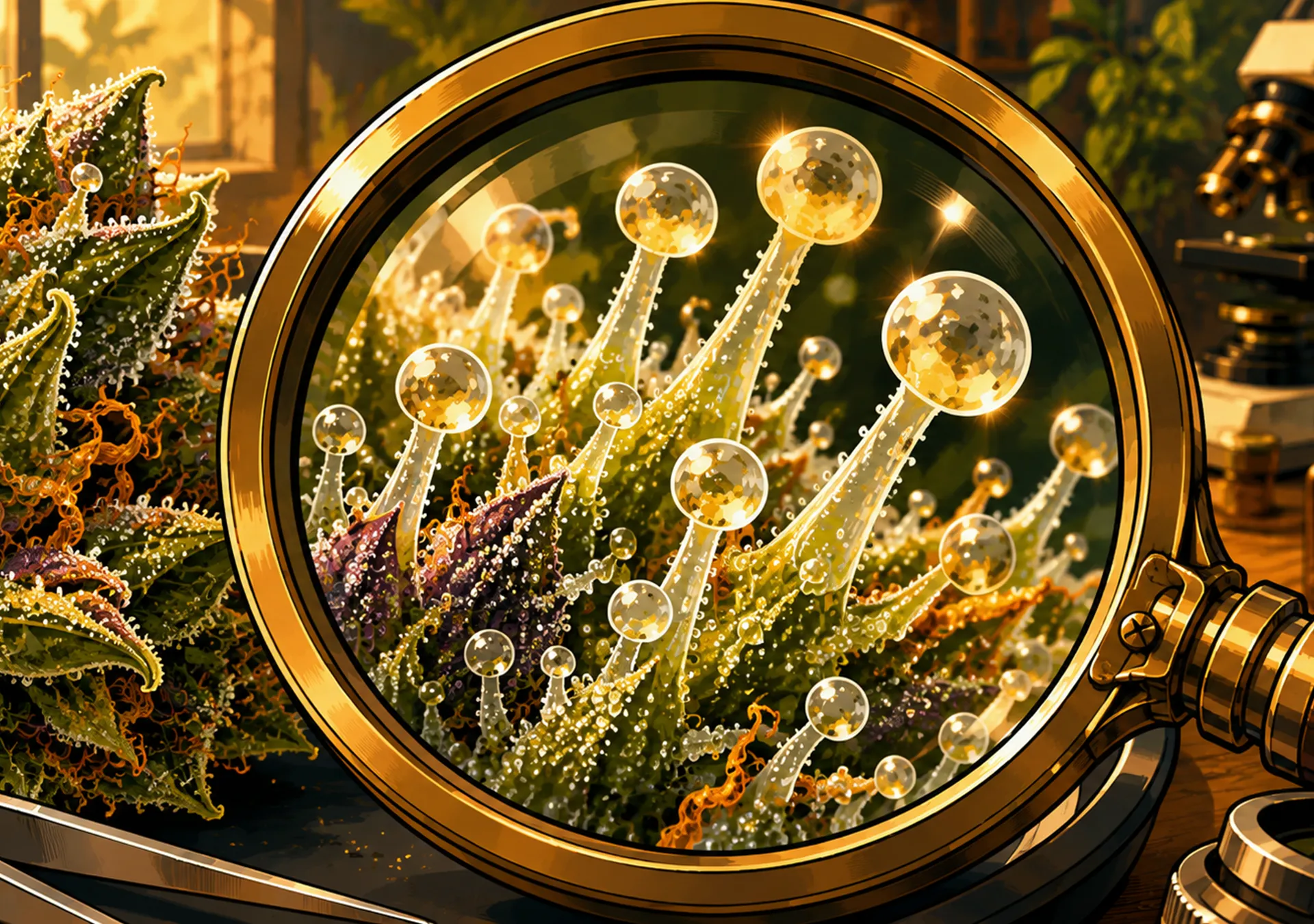
That visible “frost” is created primarily by trichomes: microscopic structures that develop across the surface of cannabis flowers and nearby leaves. They are among the most important parts of the plant because they produce and store much of the cannabinoids, terpenes, and other compounds associated with cannabis aroma and chemistry.
More visible trichomes can be an encouraging sign, but frostiness is not a complete quality grade. Genetics establish how heavily a plant can develop trichomes. Cultivation and harvest timing influence how those genetics are expressed. Drying, trimming, packaging, and storage determine how much of that delicate surface survives until the flower reaches a customer.
Even lighting can change how frosty the same bud appears.
The result is a visual characteristic that tells us something meaningful about cannabis, but not everything.
The Frost Is Made of Trichomes
Trichomes are tiny structures that grow from the surface of many plants. In nature, they can serve several functions, including helping protect plants from insects, environmental stress, and ultraviolet exposure.
On female cannabis flowers, glandular trichomes are especially important because they act as microscopic production and storage sites for compounds including THCA, CBDA, terpenes, and flavonoids. The secretory cells inside a trichome produce these compounds, which accumulate beneath the outer surface of its rounded head.
To the naked eye, a dense collection of trichomes can look like frost or fine sugar crystals. Under magnification, the surface is more complex: thousands of small stalks and rounded glandular heads rise from the flower’s bracts, calyxes, and surrounding sugar leaves.
Cannabis develops several forms of glandular trichomes, commonly described as bulbous, sessile, and capitate-stalked.
Bulbous trichomes are the smallest. Sessile trichomes have rounded heads positioned close to the plant surface. Capitate-stalked trichomes develop larger heads on longer stalks and become particularly abundant on mature female flowers. They also contain more secretory cells and are generally responsible for the greatest share of cannabinoid production among the three forms.
When consumers describe flower as heavily frosted, they are usually responding to the number, size, visibility, and condition of these capitate-stalked glandular trichomes.
Genetics Establish the Plant’s Frost Potential
Some cultivars are naturally more resinous than others.
Just as cannabis genetics influence plant height, flower structure, color, aroma, cannabinoid ratios, and resistance to environmental stress, they also influence trichome development. Different genetic lines may produce different trichome densities, head sizes, stalk lengths, and patterns of distribution across the flower. Research has found that trichome development and morphology vary with genotype as well as plant age.
This is why certain families of cannabis consistently produce the kind of flower that photographs exceptionally well. Breeders may select plants that show unusually dense gland coverage, pronounced aroma, strong cannabinoid production, or other resin-related traits, then continue working those characteristics through later generations.
Modern commercial breeding has placed considerable emphasis on visible resin production. A recent comparison of selected modern cultivars and older landrace accessions found that the modern plants examined developed larger and more productive trichomes, reflecting how targeted selection can change the physical characteristics of the plant’s resin glands. That finding should not be generalized to every modern or traditional cultivar, but it demonstrates how strongly breeding can shape visible frost.
Genetics are therefore the starting point.
A skilled cultivation team can help a cultivar express its potential, but it cannot force every plant to produce the same style of trichome coverage. Some flower will naturally appear snowier, while other cultivars may express their quality through aroma, unusual terpene chemistry, color, structure, or a distinctive experience rather than extreme visual frost.
Cultivation Determines How Fully Those Genetics Are Expressed
A resin-heavy cultivar still needs the right environment.
Light intensity and distribution, temperature, humidity, nutrition, irrigation, airflow, plant health, and canopy management can all influence flower development and plant chemistry. Researchers continue to study exactly how these factors affect trichome density and cannabinoid production, and the results are not always simple or universal across cultivars.
Light is one of the most visible examples.
Cannabis flowers positioned in well-lit areas of the canopy may develop differently from shaded lower flowers. Studies have found differences in cannabinoid and terpene levels according to flower position, with upper plant regions often receiving more light and producing different chemical concentrations than lower areas. Increasing light intensity can also increase yield and alter flower development, although the response depends on genetics, growing conditions, and the specific range of light being studied.
This helps explain why the largest top flowers from a plant can sometimes look denser and more heavily frosted than smaller buds harvested from lower branches.
Nutrition can also influence trichome development, but the relationship is more complicated than “more nutrients create more resin.” One study found that nutrient levels and beneficial bacterial treatments altered stalked-trichome density and cannabinoid profiles in a cultivar-dependent experimental setting. The results show that cultivation conditions matter, but they also caution against treating a single feeding schedule or stress technique as a universal formula for frostier flower.
The cannabis world is filled with claims that one specific stress, nutrient, light spectrum, or late-flower technique automatically increases resin production. Scientific evidence remains more nuanced. A cultivation method that benefits one cultivar under controlled conditions may have little effect, or an undesirable effect on another.
Healthy plants, stable environmental control, even light distribution, and cultivar-specific experience remain more reliable than a one-size-fits-all “trichome hack.”
Flower Position Can Change What You See
Trichomes are not distributed perfectly evenly across a cannabis plant or even across a single flower.
They occur heavily on the bracts and calyxes surrounding female flowers, while also extending onto the small leaves commonly called sugar leaves. Different plant surfaces may carry different proportions and stages of glandular trichomes.
That variation creates several visual effects.
A flower with slightly more sugar leaf left around it may appear extremely frosty because those leaves can carry a visible coating of resin glands. Another flower may be trimmed more closely, exposing the denser underlying structure but removing some of the surfaces that reflected light.
Neither trim style proves quality by itself.
A leafy bud can use trichome-covered sugar leaves to create a frosty first impression while containing less desirable plant material than a cleaner trim. On the other hand, aggressive trimming can remove or damage the outer trichomes along with the leaf.
The most careful finishing work tries to find a balance: removing excess leaf and stem without unnecessarily scraping away the fragile glandular heads that the grower spent months developing.
Trichomes Change as the Flower Matures
Cannabis trichomes are not static decorations. They develop alongside the flower.
Early in flowering, many glandular structures are small and positioned close to the plant surface. As the flower matures, capitate-stalked trichomes become more prominent, their stalks lengthen, and their glandular heads expand. Research has documented meaningful changes in trichome density, morphology, and color during flower development.
Under magnification, growers often observe trichome heads moving through clear, cloudy or milky, and darker yellow-brown appearances.
These visual changes can provide useful information about maturity, but the popular interpretation is often oversimplified. A grower cannot determine the flower’s entire chemical profile by counting amber trichomes through a loupe. Trichomes across the same flower may mature at different rates, and color can vary according to cultivar, plant position, lighting, handling, and degradation.
Scientific efforts to quantify maturity use controlled imaging, sampling, and chemical analysis rather than relying only on an informal glance at trichome color.
Harvest timing still affects visible frost.
Cutting too early may capture trichomes before the plant has reached its fullest development. Waiting too long can allow more glandular heads to darken, rupture, or begin degrading. An experienced cultivation team tries to harvest within the window that best matches the cultivar, the desired chemical profile, and the intended finished product.
Drying and Curing Preserve What the Plant Produced
Once a plant is cut, it cannot create new trichomes.
From that point forward, quality depends largely on preservation.
Trichome heads are physically fragile. Excessive heat, rough movement, low humidity, uncontrolled drying, and unnecessary handling can damage or detach them. This is one reason harvested cannabis must be moved, dried, trimmed, and packaged with care.
Drying reduces the flower’s moisture to a level appropriate for curing, storage, and consumption. The process needs to move steadily enough to limit microbial risk without using excessive heat or speed that can damage aroma, color, texture, and plant chemistry.
Postharvest research shows that drying conditions influence cannabinoid retention, moisture, color, microbial levels, and the stability of the finished flower.
A slower, controlled drying process may help preserve the structure and aromatic character of the flower, but “slow” does not automatically mean better. If conditions remain too humid or poorly ventilated, the crop may face mold and microbial problems.
Curing follows drying and allows moisture within the flower to become more evenly distributed while the producer monitors the batch for stability. A thoughtful cure can help protect aroma, texture, and the integrity of the finished bud.
A poor postharvest process can make naturally frosty genetics look dull. Trichome heads may collapse, darken, fall away, or become coated in plant material from excessive handling.
What Makes Cannabis Flower Frosty? A Closer Look at Trichomes
Trimming has a large influence on the flower a customer eventually sees.
Hand trimming allows a worker to follow the shape of each bud and remove leaves selectively. It is slower and more expensive, but it can reduce unnecessary contact with the flower when performed carefully.
Mechanical trimming moves flower through equipment that removes leaf material more quickly. It can create consistency and process large harvests efficiently, but the movement and abrasion may also damage surface trichomes. Reviews of cannabis postharvest processing have specifically identified the need for trimming equipment and methods that remove unwanted leaf while minimizing abrasion to glandular structures.
This does not mean every hand-trimmed bud will be frosty or every machine-trimmed bud will be damaged. Technique, equipment, flower moisture, run time, cultivar structure, and operator experience all matter.
The difference becomes most noticeable at the extremes.
Flower handled gently may retain intact, reflective gland heads that stand visibly above the surface. Flower that has been overprocessed can develop smoother edges, a dusty bottom in the container, and fewer intact heads, even if it began with excellent trichome coverage.
That loose powder at the bottom is often called kief. It contains detached trichome material that was once part of the flower’s visible frost.
Packaging and Storage Continue to Matter
A beautifully cultivated and carefully cured flower can still lose quality before it is purchased.
Heat, oxygen, light, time, and repeated movement can affect cannabinoids, terpenes, moisture, and the physical integrity of trichomes. Research examining cannabis storage has documented cannabinoid and aroma changes over time, with the rate of deterioration affected by temperature, packaging, and storage conditions.
Glass jars, rigid containers, and protective packaging may help reduce compression and physical damage. Flexible bags can be effective when properly sized and handled, but tightly packed or repeatedly squeezed flower can lose structure and trichome heads.
The amount of empty space also matters. Too much movement allows buds to strike the sides of a container during transport. Too much compression can flatten the flower and transfer resin onto the packaging.
Age changes the visual impression as well. Older flower may still show visible trichomes, but its aroma can become quieter, its texture drier, and its gland heads less reflective. Frostiness can survive longer than freshness, which is another reason appearance should not be evaluated alone.
Our article on what happens when cannabis gets too hot is a useful companion to this topic because the same heat that softens gummies and disrupts vape hardware can also accelerate the decline of flower.
Lighting Can Make the Same Flower Look Completely Different
Cannabis trichomes reflect and scatter light.
That means frostiness is partly a matter of presentation.
Direct, angled lighting makes glandular heads sparkle. Bright retail display lighting can bring out the surface texture of a bud, while flat overhead lighting may make the same flower appear dull. Smartphone flash, macro lenses, dark backgrounds, photo sharpening, and contrast adjustments can exaggerate the crystalline appearance even further.
This does not mean product photography is necessarily deceptive. Trichomes really are present, and professional lighting is designed to reveal texture.
It does mean a photograph should not be treated as a laboratory measurement.
The most dramatic macro image may show a few millimeters of one carefully selected flower. It cannot tell you how the rest of the batch was trimmed, how fresh it is, how it smells, or how consistently the jars were filled.
Even inside a transparent package, curved plastic or glass can magnify highlights and make resin glands appear larger. A consumer comparing flower under two different lighting conditions may believe one is significantly frostier when part of the difference is optical.
Does Frostier Flower Contain More THC?
Sometimes, but the relationship is not simple enough to judge by sight.
Cannabinoids are produced and stored largely within glandular trichomes, and studies have found relationships between gland number and cannabinoid content. A flower with abundant, mature glandular trichomes may therefore have meaningful cannabinoid-producing capacity.
But visible frost does not reveal:
- Which cannabinoids are present
- Their concentrations
- The chemical profile inside each trichome
- How many trichome heads remain intact
- Whether the visible glands are concentrated on flower bracts or leftover leaf
- Whether the flower is fresh
- How much aroma remains
- How the sample tested in a laboratory
Modern research has highlighted the difficulty of comparing trichome density across different plant surfaces and studies because sampling methods are not standardized. Density can differ depending on whether researchers count trichomes on bracts, sugar leaves, calyxes, or an entire flower.
There is also variation inside individual trichomes. Researchers analyzing single glands have found chemical diversity that cannot be identified from external appearance alone.
A very frosty flower can test high in THCA, but it might also be notable for a different cannabinoid profile. Two similarly frosted cultivars can contain different concentrations and produce noticeably different experiences.
The only reliable way to quantify cannabinoids is through appropriate laboratory analysis, not eyesight.
Frostiness Does Not Automatically Mean Better Cannabis
The cannabis market has trained consumers to respond to a few obvious visual signals:
- Large buds
- Deep purple coloration
- Bright orange pistils
- Dense structure
- Heavy frost
All of these can be attractive. None independently proves that a flower is exceptional.
A heavily frosted bud can still be:
- Overdried
- Poorly cured
- Weak in aroma
- Harsh when consumed
- Old
- Inconsistently trimmed
- Damaged by heat
- Mislabeled
- A poor value for its price
Less visually dramatic flower may offer a more expressive terpene profile, better moisture, a cleaner cure, or a more enjoyable experience.
This does not make frost meaningless. Trichomes are central to cannabis chemistry, and well-preserved glandular coverage is a legitimate sign of plant development and careful handling.
The mistake is treating one visible characteristic as the final verdict.
Quality is cumulative. It comes from genetics, cultivation, harvest timing, drying, curing, trimming, testing, packaging, freshness, aroma, and how the product performs when used.
How to Evaluate Frosty Flower as a Consumer
When viewing cannabis flower, treat trichome coverage as one part of a larger inspection.
Look Beyond the Sparkle
Notice where the frost appears. Is it distributed across the actual flower, or is most of it sitting on untrimmed sugar leaves? Do the buds retain their shape, or do they look flattened and overhandled?
Under magnification, intact glandular heads are a better sign than a surface that simply looks dusty.
Check the Packaging Date
Visible trichomes can remain on flower after aroma and moisture have declined. A fresher package is not automatically better, because cannabis needs adequate drying and curing, but the date provides important context.
Pay Attention to Aroma
A healthy aroma can reveal qualities that appearance cannot. The flower should smell expressive for its cultivar rather than like dry grass, cardboard, excessive moisture, or nothing at all.
Trichomes produce and store many aromatic compounds, but those compounds can evaporate or degrade even while some visible gland structures remain.
Consider Texture
Flower should generally feel dry enough to separate and grind without feeling wet, but not so brittle that it immediately turns to powder.
Customers should avoid repeatedly squeezing buds inside a package. That familiar “squish test” can damage the very trichomes being evaluated.
Use Test Results as Context
Cannabinoid testing can confirm potency and provide information that the eye cannot. It should be considered alongside the flower’s freshness, aroma, cure, genetics, and intended experience, not used as the only definition of quality.
Ask About the Producer and Batch
A knowledgeable dispensary team may be familiar with the cultivator, previous harvests, customer response, packaging date, and how the current batch compares with earlier releases.
Cannabis is an agricultural product. Even respected producers can have variation between cultivars and harvests.
A Sign Worth Noticing, Not Worshipping
Frosty cannabis is visually compelling because it allows us to see part of the plant’s chemistry.
Those tiny reflective glands are where much of the flower’s cannabinoid and terpene production takes place. Their density begins with genetics, develops through cultivation and maturity, and is either protected or diminished by everything that happens after harvest.
That makes frostiness worth noticing.
It can suggest resinous genetics, careful cultivation, appropriate harvest timing, and gentle handling. It can also be amplified by leafy trimming, lighting, photography, or packaging. It cannot tell you the full cannabinoid profile, guarantee freshness, or predict whether the flower will provide the experience you prefer.
At Tropicanna, appearance is one part of how flower is considered, not the entire standard. We also look at the producer, batch consistency, testing, aroma, cure, packaging, freshness, and whether the product delivers reasonable value within its category.
The frost may be the first thing you notice.
The rest of the flower determines whether it deserves your attention.