
Ancient Weed Discoveries That Reveal Cannabis History’s Strangest Secrets
Long before dispensaries, glass jars, strain names, or even the modern idea of smoking a joint, people were already cultivating, carrying, burning, preserving, and apparently consuming cannabis across large parts of Eurasia and Africa.
We know this because some of it survived.
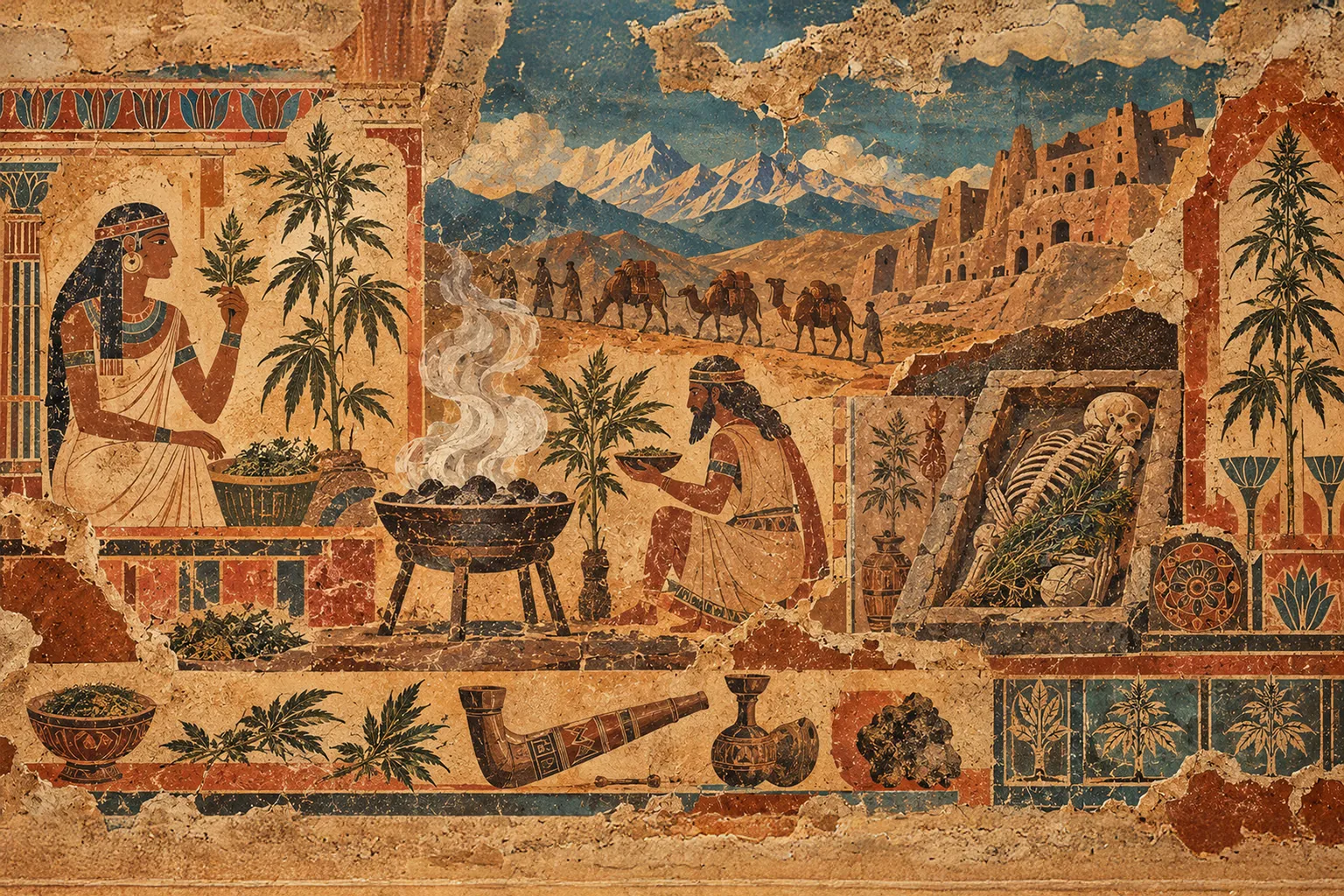
Archaeologists have uncovered cannabis buried beside human remains, entire plants arranged across a corpse, wooden containers used to burn psychoactive cannabis during funeral ceremonies, ancient altars carrying cannabinoid residue, and centuries-old smoking pipes that still contained chemical evidence of the plant.
Some discoveries are so well preserved that researchers can identify individual seeds, flowers, roots, trichomes, and chemical compounds thousands of years later.
Others leave us with more questions than answers.
Together, they reveal something fascinating: humans have had a relationship with cannabis for an extraordinarily long time, and that relationship was about much more than simply making rope.
Here are some of the strangest pieces of evidence ever pulled out of the ground.
A 2,500-Year-Old Cannabis Hotbox in the Mountains of Central Asia
One of the most important discoveries in cannabis archaeology came from a cemetery more than 10,000 feet above sea level in the Pamir Mountains of western China.
At the Jirzankal Cemetery, archaeologists excavated tombs dating to roughly 500 BCE. Inside several of them were unusual wooden containers filled with stones that showed signs of intense heating.
The objects were braziers, essentially containers used to hold heated material.
Researchers were curious about what had been burned inside them.
Chemical analysis revealed the answer.
Cannabis.
More specifically, the residues contained cannabinoid markers indicating that plants with relatively high levels of psychoactive compounds had been burned inside the braziers.
The discovery became one of the earliest directly dated and scientifically verified examples of people intentionally burning cannabis for its psychoactive effects.
The method was nothing like modern smoking.
Researchers believe people placed hot stones inside the wooden braziers and added cannabis, causing the plant material to release smoke or vapor. Given that the braziers were found inside a cemetery, the practice appears to have been connected to funerary or ritual ceremonies.
Imagine entering an enclosed space in the mountains 2,500 years ago while cannabis smoldered over heated stones.
It sounds surprisingly similar to an account written during roughly the same period by the Greek historian Herodotus.
Herodotus Wrote About Something Very Similar
Around the fifth century BCE, Herodotus described a cannabis ritual practiced by the Scythians, nomadic peoples who lived across the Eurasian steppe.
According to his account, participants entered small enclosed tents and threw hemp onto heated stones. Smoke filled the enclosure, and Herodotus described the participants reacting enthusiastically to the vapor.
For centuries, historians debated exactly what he had witnessed and whether the description could be trusted.
Then archaeology started producing evidence that sounded remarkably familiar.
The Jirzankal braziers were found far east of the areas most closely associated with the Scythians, so researchers are not claiming the cemetery directly proves Herodotus’ specific account.
But it does demonstrate that people in Central Eurasia were using hot stones and cannabis in ritual contexts during approximately the same broad historical period.
Sometimes archaeology does not confirm an ancient story word for word.
It simply makes the story suddenly sound a lot less unbelievable.
Someone Was Buried With Almost Two Pounds of Cannabis
Another remarkable discovery came from the Yanghai Tombs near Turpan in northwestern China.
The cemetery contained thousands of ancient graves preserved unusually well by the region’s extremely dry climate.
One burial stood out.
Inside Tomb M90, archaeologists found the remains of a man believed to have held relatively high social status. His burial included archery equipment, horse-related objects, a musical instrument, and something archaeologists initially mistook for another dried plant.
It turned out to be cannabis.
A lot of cannabis.
A leather basket and wooden bowl near the body contained approximately 789 grams, or around 1.7 pounds, of preserved plant material.
The burial dates to roughly 2,700 years ago.
The condition of the cannabis was extraordinary. Researchers were able to examine recognizable leaves, seeds, trichomes, and other botanical structures. Chemical and genetic testing also indicated that the plants were associated with THC production.
This was not simply industrial hemp placed beside the deceased because it happened to be useful for making fabric.
Researchers found no hemp textiles in the tomb, and the plant material itself appeared to have been selected for properties consistent with medicinal, psychoactive, or ritual use.
Exactly how the cannabis was consumed remains unknown.
There was no ancient bong sitting next to the basket.
It could have been burned, inhaled, consumed orally, used medicinally, incorporated into rituals, or handled in a way archaeologists have not yet identified.
That uncertainty makes the discovery even more interesting.
We know the cannabis was important enough to place beside the dead.
We just do not know exactly what they were doing with it.
The Desert Preserved Cannabis for 2,700 Years
The Yanghai discovery also demonstrates how much archaeology depends on luck.
Cannabis is plant material.
Normally, plant material decomposes.
Leaves disappear. Flowers break down. microorganisms consume organic matter. Moisture, insects, temperature, soil chemistry, and time gradually erase much of the evidence.
The Turpan Basin created unusual preservation conditions.
Extremely low rainfall, dry soil, deep graves, and the surrounding desert environment helped preserve human remains and organic materials that would have disappeared almost anywhere else.
That is why researchers could still study cannabis trichomes after more than two millennia.
The plant had not remained chemically unchanged. THC naturally degrades over time, and researchers detected degradation products such as cannabinol, or CBN.
But enough survived to reconstruct part of the plant’s original chemistry.
In other words, ancient cannabis left behind a chemical fingerprint.
Thousands of years later, scientists could still read it.
One Man Was Literally Buried Under Cannabis Plants
If a basket containing nearly two pounds of ancient cannabis sounds unusual, another discovery from the same general region goes even further.
At the Jiayi Cemetery in China’s Turpan Basin, archaeologists excavated the grave of an adult man dating to roughly 2,400 to 2,800 years ago.
Across his body were 13 nearly complete cannabis plants.
Not processed flower.
Not seeds in a container.
Whole plants.
They had been arranged diagonally across the body like a burial shroud. Their roots and lower stems were grouped near the pelvis, while their stalks extended upward toward the chest and face.
Because of the region’s dry environment, the plants remained remarkably recognizable.
Researchers identified them as female cannabis plants and concluded that they had likely been grown locally rather than transported from a distant region.
The arrangement was clearly deliberate.
Someone gathered these plants and placed them over the deceased as part of the burial.
Why?
We do not know.
The plants may have carried religious significance. They may have been intended for use in an afterlife. The person may have been involved with cannabis medicinally or ritually while alive.
Archaeology can tell us what was placed in the grave.
It cannot interview the people who placed it there.
That gap between evidence and explanation is where ancient cannabis becomes especially fascinating.
Ancient Cannabis Was Not Always About Getting High
One reason cannabis archaeology can be difficult to interpret is that humans have used the plant for many completely different purposes.
Cannabis stalks contain strong fibers.
Seeds can be eaten and pressed for oil.
Different cannabis populations produce dramatically different concentrations of cannabinoids.
A piece of ancient hemp cloth and a container of cannabinoid-rich flowers may come from the same species while representing completely different human relationships with the plant.
Archaeologists have found ancient evidence of hemp fiber use dating much farther back than the clearest evidence for psychoactive cannabis consumption.
That makes terminology important.
Finding cannabis pollen does not automatically mean people were getting high.
Finding hemp textile does not prove people understood THC.
And discovering cannabis seeds does not necessarily reveal what the plant was being used for.
The strongest discoveries are the ones where multiple forms of evidence line up.
That is why residue chemistry has changed the field.
Scientists can now analyze microscopic chemical traces left behind on objects and sometimes determine what people actually burned or processed thousands of years ago.
Which leads to one of the strangest discoveries of all.
Cannabis Was Burned on an Ancient Religious Altar
In the 1960s, archaeologists excavated a small Iron Age shrine at Tel Arad in what is now southern Israel.
The shrine belonged to the ancient Kingdom of Judah and dates to the eighth century BCE.
Two limestone altars were found at the site.
Dark organic material remained preserved on their surfaces.
For decades, nobody knew exactly what it was.
Modern chemical analysis finally produced an answer.
One altar contained frankincense.
The other contained cannabis.
Researchers detected THC, CBD, CBN, and other compounds associated with cannabis on the smaller altar.
Even stranger, the cannabis appears to have been mixed with animal dung.
That detail sounds bizarre until you understand the chemistry.
Researchers believe the dung may have helped the cannabis burn or heat at a relatively low temperature, allowing the cannabinoids and aromatic compounds to vaporize rather than simply being destroyed by intense heat.
The frankincense on the other altar appears to have been mixed with animal fat for a similar reason.
The discovery provided the first archaeological evidence of cannabis being burned in a ritual context within ancient Judah.
It also suggests that whoever prepared the altar understood something practical about how the material behaved when heated.
They may not have known the word “THC.”
They apparently knew how to get the plant to release what they wanted from it.
The Cannabis at Tel Arad Probably Had to Travel
Another interesting detail is geography.
Cannabis was not known to grow naturally around Tel Arad during that period.
That raises the possibility that the material arrived through long-distance trade.
Frankincense itself came from farther south, likely through trade networks connecting Arabia and the Mediterranean world.
Cannabis may have traveled through similar networks from farther east.
If that interpretation is correct, cannabis was not merely something people happened to gather locally.
It was valuable enough to move.
That changes the picture considerably.
By the first millennium BCE, large portions of Eurasia were already connected by trade, migration, warfare, pastoral routes, and cultural exchange. Plants traveled along those networks just as metals, textiles, spices, animals, and ideas did.
Cannabis may have been one of them.
The plant’s history is therefore not only a story about cultivation.
It is also a story about people moving across continents.
Some of the Oldest Cannabis Smoking Pipes Were Found in Africa
When modern consumers think about ancient cannabis, Central Asia tends to dominate the story.
Africa adds another fascinating chapter.
Archaeologists working in eastern and southern Africa have found smoking pipes dating to centuries before tobacco arrived on the continent from the Americas.
That immediately raises a question.
What were people smoking?
At Lalibela Cave in Ethiopia, ceramic pipe bowls associated with deposits dating to roughly the 13th or 14th century CE were chemically tested.
Researchers detected compounds consistent with cannabis residue.
The findings have long been cited as evidence that cannabis was being smoked through pipes in medieval Africa.
There is some archaeological caution required here. Researchers have debated how securely the individual pipes can be linked to particular dated layers because the site had been disturbed over time.
Still, the broader evidence for pre-tobacco cannabis smoking in parts of Africa is significant.
Archaeologists have identified early clay pipes across several regions, and historical research suggests cannabis smoking traditions were established before tobacco became widespread.
The image is striking.
Long before a modern glass pipe existed, people were already engineering devices specifically to inhale smoke from plants.
Cannabis appears to have been one of the major reasons.
The “Oldest Weed Pipe” Is Harder to Identify Than It Sounds
This is where archaeology ruins a perfectly good headline.
It would be satisfying to point to one object and declare it the oldest weed pipe ever found.
The evidence does not cooperate quite that neatly.
Some ancient pipes have secure dates but no surviving chemical residue.
Others contain cannabis residue but come from archaeological layers whose exact dating has been debated.
And some ancient cannabis use did not involve pipes at all.
The Jirzankal discovery is a perfect example.
Those people were clearly inhaling cannabis fumes around 2,500 years ago, yet there was no pipe. They used heated stones and wooden braziers.
The technology used to consume cannabis has changed repeatedly across history.
Hot stones.
Braziers.
Incense-style altars.
Water pipes.
Clay pipes.
Eventually rolling papers, glass pieces, vaporizers, concentrates, and devices nobody in an ancient cemetery could possibly have imagined.
The delivery system changed.
Human curiosity about the plant apparently did not.
Ancient Cannabis May Already Have Been Selected for Potency
Perhaps the most surprising part of the Jirzankal discovery is what researchers found chemically.
The cannabis burned in the braziers appeared to contain unusually high levels of compounds associated with psychoactive cannabis compared with many wild populations.
That leaves several possibilities.
People may have deliberately cultivated stronger plants.
They may have selectively collected naturally potent cannabis growing at high elevations.
Or humans moving plants across regions may have unintentionally created populations with different chemical characteristics.
We cannot know exactly which process occurred.
But the evidence suggests that ancient people were not simply throwing random hemp stalks onto a fire.
They appear to have been using cannabis that produced meaningful psychoactive effects.
If selection was intentional, the basic logic behind cannabis breeding is much older than modern strain culture.
Find the plants that produce the characteristics you value.
Save them.
Grow them again.
Repeat.
The technology surrounding cannabis has become dramatically more sophisticated.
The underlying relationship between humans and plant selection is ancient.
Archaeologists Have to Separate Evidence From Cannabis Mythology
Cannabis history attracts myths almost as quickly as cannabis genetics does.
Claims circulate online that ancient Egyptians used cannabis constantly, that specific biblical passages unquestionably describe marijuana, that famous historical figures smoked modern-style cannabis, or that archaeological objects were “ancient bongs” despite limited evidence.
Some claims eventually turn out to have substance.
Others fall apart when researchers reexamine the evidence.
That is why discoveries such as Jirzankal, Yanghai, Jiayi, and Tel Arad matter so much.
They do not rely solely on interpretation.
There is physical material.
There are botanical remains.
There are radiocarbon dates.
There are identifiable plant structures.
There are cannabinoid residues detected through modern analytical chemistry.
The evidence still requires interpretation, but there is something tangible underneath the story.
That gives us a much stronger foundation than folklore alone.
What Archaeology Still Cannot Tell Us
Finding ancient cannabis does not mean we know exactly what the experience meant to the people using it.
A modern consumer might see THC residue and immediately frame the discovery in recreational terms.
Ancient societies may not have separated recreation, medicine, spirituality, and ritual as neatly as we do.
A psychoactive plant could have occupied all of those roles at once.
Cannabis placed beside a deceased person might have been medicine, an offering, a spiritual tool, a status symbol, or something entirely different.
Cannabis burned during a funeral could have altered consciousness while also serving symbolic or religious purposes.
The chemistry tells us what was there.
Understanding what people believed about it is much harder.
That is part of what keeps archaeologists digging.
Every discovery answers one question and creates several new ones.
Cannabis History Is Much Older Than Cannabis Culture
Modern cannabis culture often feels young because so much of its familiar language is recent.
OG Kush.
Gelato.
Pre-rolls.
Live resin.
Dispensaries.
THC percentages.
Mylar bags.
Vape cartridges.
None of those concepts would mean anything to someone living 2,500 years ago.
Cannabis itself would.
The person buried beneath 13 cannabis plants knew the plant.
The people feeding cannabis onto hot stones in the Pamir Mountains knew the plant.
Whoever prepared the cannabis on the altar at Tel Arad knew the plant.
People carrying cannabis across trade routes knew it well enough to consider it worth transporting.
Their relationship with cannabis looked nothing like ours.
But there is a continuous thread running through the history.
Humans found a plant with unusual properties.
They kept finding reasons to use it.
From Ancient Braziers to a Modern California Menu
It is hard not to think about the contrast.
At Tropicanna, someone can walk into a licensed dispensary in Santa Ana and choose between dozens of flower genetics, precisely portioned edibles, concentrates produced with modern extraction equipment, and products tested for cannabinoids down to the milligram.
More than two thousand years ago, someone in Central Asia was placing cannabis over heated stones.
The technologies could not be more different.
The curiosity behind them feels surprisingly familiar.
That is one of the reasons cannabis history is worth exploring. The plant did not suddenly become culturally important when California legalized it, or when modern breeders started naming strains, or even when prohibition turned it into a political issue.
Humans were experimenting with cannabis long before any of that existed.
Sometimes the evidence survives as a chemical trace on an altar.
Sometimes it survives inside a wooden bowl buried in the desert.
And sometimes archaeologists open a 2,500-year-old grave and find an entire person covered in weed.
Cannabis history does not need much embellishment.
The real version is already strange enough.